Wednesday, October 12, 2016

Some Historical Perspective


I figure it’s time now, about three weeks or so away from the American Presidential Election of 2016, for me to tell a little story.

In the first quarter of the 20th century, American industry was in the throes of the great revolution that changed our country and the world forever. There was an almost insatiable need for cheap labor in American coal mines, steel mills, logging camps, and railroad yards. The demand was so incessant that some companies sent native born recruiters back to their countries, regions and villages of origin to try to entice their countrymen to come to America. Others worked with home grown entrepreneurs who could deliver entire work crews for a price. American industry extended an open and relatively generous hand to the poor of Europe in the early 20th century, and it worked!

At this same time, Italy, which had only been a nation for about 40 or 50 years, was struggling to recover from its war of unification. This was especially true in southern Italy, the region known as il paese di Mezzogiorno, the country of the noonday sun. Southern Italy was full of desperately poor people. About a third of the population of the Mezzogiorno, over 5 million people, passed through the relatively new immigration station at Ellis Island between 1900 and 1918. This is thought to be the largest mass migration in the 20th century. These were typically young, newly married men, and their goal was to strike it rich and go home with a bag of gold to rescue their impoverished families. It rarely worked out that way.

Giuseppe DiRado, 1972


Among the millions of new arrivals in 1911 were four young men all from the same little village in the Abruzzo who debarked together from a steamship out of Naples: Domenico Rosato, Filippo Marfisi, Giuseppe Dragani, and my grandfather, Giuseppe DiRado. Rosato and Marfisi were a little older than the other two, and had been here before, in 1906. They may have been recruiters, but I can’t say for sure. According to my grandpop, they knew that they could get work if they could get themselves to the Pa Railroad offices in the town of Harrisburg, in Pennsylvania. They also knew that Pennsylvania was right next to New York, so how far could this Harrisburg place be from Ellis Island? When the Ferry from the island dropped them in Jersey City, they discovered that train tickets would eat up most of their thin grubstakes (none of them had more than 20 dollars US). A cold November week later they presented themselves to a foreman at the Harrisburg railroad station. Following a perfunctory interview, he asked them how that got here, since he hadn’t seen them debark from any of the morning trains. They explained that they had walked all 150 miles. He hired them. 


As I said, the model most of these immigrants expected to follow was to make some money, and go home with it. In 1914, Giuseppe did just that. It might have worked out for him had he chosen another year, but 1914 was the year that the war to end all wars began. Italy decided to abandon its neutrality and join with the great alliance against the Germans and Austrians. The thought was they could grab territory away from the Austrians in the Julian and Carnic Alps above Trieste. These particular thoughts belonged to the Northern Italians and Romans who ran the army and the National Government. The people who would actually and for the most part involuntarily fight for this new territory would be the children of the Mezzogiorno. Giuseppe’s passport was confiscated in Naples. He was drafted into the Italian Army. For the next four years, this quiet, literate and sensitive man who played the mandolina, cried at hearing I Pagliacci, and composed his own poetry, was sent into some of the most brutal and bloody combat in Europe’s long and sad history. He was in the middle of the savage battles at Caporetto and Vittoria Veneto. At the end of it, over a million Italian, Austrian, Slovenian, and German kids lay dead or hideously maimed in the cold mountains from machine guns, poison gas, artillery, hand grenades, air delivered bombs, and other recent inventions of the military industry. They ran out of places to bury people, and lots of these kids just froze into alpine glaciers, where climate change has begun to reveal them in the last couple summers. When the smoke cleared, the boundary between countries was more or less where it was at the beginning of the war. Aside from the industrial scale slaughter, nothing of any geopolitical consequence actually happened.

In 1918, as a reward for surviving the whole thing physically unscathed, Giuseppe was assigned to “guard” St Mark’s Square in Venice. This meant that he was issued a dress uniform and a carbine with no ammunition, and told to walk in slow dignified circles in front of the Doge’s palazzo for one six hour shift per day. So between down time at Venice’s famous cafés, taking in the opera at la Fenice, attending poetry readings by the likes of Ezra Pound and Gabrielle D’Annunzio, and a furlough home during which my mother was conceived, he had lots of time to read the papers, think and observe. He concluded that the people who ran his country, particularly a young firebrand from the North named Benito Mussolini, were heartless, crazy and murderous bastards. Mussolini and his fascisti sycophants loudly railed against foreigners, and opined that Italy had not gained its rightful territory during the recent war because they just weren’t ruthless enough and didn’t push hard enough. Giuseppe, who had just held a front row seat for the whole thing, recognized this dangerous bullshit for what it was. He thought that the whole country was losing its collective mind. He thought that he had seen and done things so abominable in the last couple years that he could never get over them, and couldn’t imagine anyone wanting to do or see anything like that again. He thought it was time to leave.

In 1920 he returned to the States, to Harrisburg and to the railroad. His game plan was different now. He would move his family, now grown to three kids (the result of two military leaves during the war), to the new world, and he would become an American. But things would not go according to script.

My Grandmother and Her Kids, 


As I said, the millions of southern and central European immigrants who arrived here in the first two decades of the 20th century were, for the most part, invited, recruited, and cajoled by growing American industries. That said, “native born” Americans from the country’s growing middle class, the children of earlier waves of immigrants from primarily northern Europe, became increasingly uncomfortable with the new arrivals. The newcomers were overwhelmingly Catholic or Jewish, they spoke odd and unintelligible languages, some of them had dark skin, and there were Marxists and Anarchists among them. They were accused of taking jobs away from “real Americans”, of being gangsters and rapists. The roots of this anti-immigrant prejudice stretched back at least to the 1890’s, when 11 Sicilian-Americans were simultaneously lynched in the City of New Orleans. As the 20’s began the fear and suspicion blossomed into an ugly bouquet of very bad behavior. There was a revival of the Ku Klux Klan in northern states where they had never appeared before. The worst kind of bigoted invective appeared in newspapers and political speeches. A string of anti-immigrant legislation was passed including the Quota Law in 1921, and the infamous National Origins or Immigration Act in 1924. Giuseppe’s family was stranded in Italy and was not permitted to come here. After he took his oath of citizenship in 1926, he succeeded in getting the bureaucracy to relent, but there was a Sophie’s choice-type catch. Only three people could come. In May, 1927 Maria Staniscia, my Grandmother, took her children to Naples, entrusted their safety to her eldest daughter and to the wife of a family friend who would ignore them aboard ship, and kissed them a tear soaked goodbye. They were confident she would get a visa the next year, but that didn’t happen. She would not see them or her husband again for a decade, when she was finally granted a visa by the American consulate.

My Mom was only 8. The next time she saw her Mom again, she was 18. She carried the wounds from this abandonment for the rest of her life. She was a kind and decent person who never harmed a fly. She didn’t deserve it.

My Mom's Passport Photo


This leads me to a conversation I had a few years ago with a man who owns one of the large fruit growing operations in Adams County, and whose family has been there since the 18th century. In the course of a tour of his packing plant he introduced me to a Mexican woman and her son who were the third and fourth generations of their family to work for his. The son was born in York Springs, and is an American citizen. The orchard owner explained how completely the fruit business depends on the labor of Mexican and Caribbean workers who work for minimum wage or a bit more, and can put in multiple 10 to 12 hour days staying ahead of ripening fruit. Social Security, Medicare, and all applicable taxes are deducted from their checks, and in many cases they’ll never see any benefits from those programs. Their kids are enlisting in the armed services and there have been lots of them in Afghanistan and Iraq. Without these people, he believes our domestic fruit growing industry will disappear, and fruit will be grown in other countries with plentiful cheap labor and suitable growing conditions, like China, and imported to the United States.

While there is no doubt that many Latin American immigrants came here illegally, I very rarely hear any rational discussion of precisely why they do that amid the cacophony of very angry public discourse that swirls around the issue. The truth of the matter is they come here, at the behest of American agribusiness, construction, and other industries that need cheap labor to continue operating here, and they know they can make a decent wage and pull their families out of poverty if they can just get here, legally or otherwise. The orchard owner I talked with, a lifelong Republican, has been among the folks advocating for a decent guest worker program for at least a decade to eliminate the temptation of crossing the border illegally, but so far all he seems to have gotten for his advocacy is the promise of a wall that the Mexican government is apparently going to pay for.

Near the end of her long life, my Mom, who passed a decade ago, fretted about the fate of these farm workers. She read the invective in the local and national newspapers and heard the vile political speech, some of it coming from people with Italian surnames like Lou Barletta, then the mayor of Hazleton, and it depressed her. It seemed like the 20’s all over again.

And so the cycle repeats. The Irish came in droves in the 19th century to work in the mines and build the first railroads, and they were hated and feared. The turn of the century saw the immigrants who powered the industrial revolution accomplish great things, and laws were passed to keep them out. In the 40’s great waves of southern African Americans came North to work the steel mills and railroads and munitions plants and helped win the war, and were paid for it with racism. And now people come here and provide for their families by butchering chickens and picking apples, and there’s talk of a wall and mass deportations.

The story of Mr. Trump and the cowards and bigots that have rallied around him isn’t anything new. It’s old. It’s not about change, it’s about repeated and regular episodes of narrow-mindedness, fear, cruelty and ignorance that have millennial roots. It springs from the same polluted well that brought us Senator McCarthy, Mussolini, Hitler, Stalin, Pol Pot and so on. There are lots of people who are going to vote for him in a few weeks who don’t know anything about history and don’t want to. They don’t see themselves in these new immigrants, even though they all came here from somewhere else, and have ancestors who suffered at the hands of people who were just as heartless and vicious as they themselves have become. It’s dusty, ancient history for them, but it’s not for me. I saw my mother’s tears with my own eyes.

I see the danger here very clearly, just as my Grandfather did reading the papers along the Canale Grande in 1918. I will be at the polls when they open on the 8th.

Sunday, August 28, 2016

Rod Number 2


The paste wax needs about 20 minutes to set up, at which point it has jelled into an ugly yellow haze that masks the wood beneath it. Starting with the butt section, I buff away the wax with a soft cloth, and a final transformation reveals itself. The flamed bamboo, previously rubbed with the finest grade of steel wool, and wiped fee of dust with denatured alcohol, has already received 7 very thin coats of pure tung oil. The final buffing of paste wax brings the finish to a golden brown luster, that appears to make the cane translucent. It glows with an internal fire, revealing its structure of supportive and conductive tissue, and the small irregularities of its surface become beauty marks. I have at least 50 hours in this fly rod, and for the most part all I see are the imperfections and mistakes and things I could do better, but right now, in this final revelatory moment, it takes my breath away.

What follows is a succinct description of the making of a cane fly rod, the first one I’ve built completely on my own. Since most of my readers, friends and family don’t fish, I’ll keep it simple and, I hope, instructive and interesting. In the process I will relate what I have learned in the making of the rod, much of which doesn’t have anything to do with fishing poles.

.................................................................................................

Preparing and Splitting the Culm

Not any bamboo will do… For generations now, 12 foot lengths of Tonkin Cane (Arundinaria amabilis McClure) have been imported from a small region of Southern China along the Sui River, north and west of Hong Kong. Tonkin cane is the toughest of the many varieties of bamboo; it’s used in China to build commercial scaffolding. The stuff is heavy and dense and also beautiful as its name suggests (the Latin translates to Lovely Reed). It gets a lot tougher (and darker) when exposed to the flame of a propane torch. The fire drives the residual water from the stick or culm of bamboo. The flaming process also releases the delicious smell of cane into the workshop. The grass family, of which bamboo is a member, also includes sugar cane and sorghum, and the sugar in the wood produces a wonderful aroma of caramel, that is released whenever the culm is exposed to heat or is cut, split or planed. That delicious smell is an integral part of working with cane, and permeates my little workshop. After the cane is flamed and hardened, it’s carefully split with a froe or knife blade. Initially the culm (now sawed into a pair of 6 foot lengths) is split into six more or less equal
strips, then each strip is again split into three or four thinner strips. This is the first of many slow and painstaking processes that will many hours later, produce a fishing rod. It’s deliberate. It takes patience.

…………………………………………………………………………

I’ll be 60 this year. Two years ago I damn near died. I am almost daily reminded now of the proximity of the hereafter and related disasters. The current list of recent dire portents includes encounters with pediatric cancer, a couple of brutal divorces, the loss of a beloved old dog, and other kinds of wreck and ruin within my family and circle of friends. Time presses and the days whirl by with frightening speed. Understand, I’m not running scared. I am a happy man, but I am driven. There is a relaxed urgency in my life that is new and welcome.

Working with cane has been a boon to me in part because it simply does not yield to the rush of impatience. Rod building requires accurate work to tolerances measured in a few thousandths of an inch. Rushing will not help you and speed is not your friend. Patience and focus are required, as is persistence. The urgency I live with now drives me out into the shop at the end of a long work day, but once I’m in there, the need to press yields to the discipline of the cane and the methodical and careful application of the tools to the wonderful and sometimes obstinate material. The sound of rending cane marks the slow passage of the knife through the strip, the sweet smell of bamboo permeates the workshop. Fiddle music drifts quietly from the radio. Time doesn’t stand still, but it slows down some, and that’s enough.

………………………………………………………………………………………………

Selection, Cutting and Straightening, Rough Planing

The 35 or 40-odd strips produced by a split culm are the essence of what will become a fly rod. Most cane rods are hexagonal in cross-section, composed of six strips per section, planed on a 60-degree bevel. The rough strips are sort of flat, crooked, and will always include a number of growth rings called nodes. Analogous to knots in hardwood, the nodes are sections of very tough, but brittle fibers that present all manner of difficulties and challenges to the builder. Strips crack and break easily at the nodes, and they’re never straight. They also protrude a bit from the strip’s outer surface. The rodmaker is always at war with the nodes, down to nearly the final stages of production. A two piece, two tip rod will require 18 strips. A three piece, two tip rod like Number 2, will require 24. This assumes you won’t fuck any of them up in production, and of course, you will. It is also in this early stage that you will select the strips for the rod, and lay them out so that no two strips have any nodes next to each other or within four inches or so of the tip or butt of any section. This insures the rod will have no weak spots prone to breaking and will cast smoothly and behave predictably. When suitable strips are selected, they’re cut to length (usually four inches or so longer than they need to be), numbered, and bundled together by section. Each strip is then carefully evaluated and straightened using a heat gun or alcohol lamp, hand pressure and a vice. In addition, each node is sanded or filed flat on the outside
surface, and planed flat on the inner surface. Finally, each strip is placed in a rough, 60-degree form (mine is an oak board with grooves cut in it with a router) and the planing begins. A small mountain of shavings, and many hours later, one is left with 6 more or less straight strips per rod section that form a hexagon when bound together, but lack the taper of a finished rod section. That will require another form, and more planing. In the next phase of the process, the hexagonal stick will become a fly rod.

…………………………………………………………………………………………………………

The practice of building cane rods connects one to a craft that is almost two centuries old. It’s especially old here in Pennsylvania, where Samuel Phillippe built the earliest strip-built cane rods in Easton during the 1840’s. By the 1870’s, Hiram Leonard’s shop in Maine was producing six-strip bamboo rods that would become models for rodmakers to the present day. Leonard’s shop in turn produced a couple of generations of craftsmen whose fishing rods are famous for their performance and beauty. Among them was Jim Payne, whose dad had worked at Leonard. Jim Payne built rods for decades, many with a distinctive and powerful feel that works well for folks like me who learned to cast with fiberglass and graphite. Rod number 2 is a Jim Payne taper, converted from two to three pieces.

The point is, practitioners of this craft stand on the shoulders and accomplishments of craftsmen (and women) who were at it before our parents or even grandparents were born. My mentors include George Maxwell of Nazareth Pa who started me down the path with a week of instruction in his shop three years ago. Then there’s Bill Taylor, who’s shop was the first one I actually saw with my own eyes and who built the sweet little rod I fish small streams with. Bill Harms, Wayne Cattenach, and especially Jerry Kustich have generously answered my endless questions when I talked with them at various shows and workshops over the years. These guys are, in turn, all connected to their own mentors in places as far apart as Pennsylvania, Michigan, San Francisco and Montana, folks who trace their own lineages back to Leonard and Phillippe. I am, in a slow, halting, still mistake-filled beginner’s way, now a part of this community. The splitting froe, the forms, the block planes, the taper formulas, and all the accoutrements of rod building connect me to a tradition and to a lineage.

You can buy a graphite rod that weighs a fraction of the weight of a cane rod of similar length. It will be cosmetically beautiful and cast like a cannon, and you won’t have to spend weeks waiting for it to materialize. But it won’t be a product of human hands and patience and unbroken tradition and decades of accumulated knowledge.


You can’t buy that.

………………………………………………………………………………………………………

Planing the Taper


Mounted on a two by four atop my workbench is my planning form. I was made for me by a machinist in Colorado, and it’s typical. It’s about five feet long, and composed of a pair of steel bar-stock sections with a 60-degree beveled channel between the two bars. At 5 inch centers there are set screws on each side of the form. By careful use of dial depth gauge and a couple of allen wrenches, the depth of this channel can be manipulated in increments measured in thousandths of inches.

Next to the planing form, laying on its side to protect the blade, is my best block plane. The plane was made by a small tool company in Maine, and cost me an arm and a leg. That’s alright, it was worth it. You can get it as sharp as a razor, it stays sharp, and you can adjust the exposure of the blade in such infinitesimal increments that it can remove shavings that are only a couple thousands of an inch in thickness. These shavings look like dust.

The “actions” of fly rods, that is their behavior as casting tools, are almost completely controlled by their taper from butt to tip. These tapers have been developed by many fine craftsmen and women over the decades. Some have been around since the Leonard shop opened, and they’re still great, some are products of computer-aided-drafting programs and are thoroughly 21st century. They can be surprisingly different from each other. Some tapers are “slow” that is, the rod flexes deeply into the butt and the required casting stroke is deliberate, some are “fast” and these rods can feel very stiff. While fast rods are perhaps less delicate, they can shoot line like a howitzer. There is every graduation of action in between.

The taper is the product of the planing form, the block plane, and very careful and delicate work. The closer you get to the final dimensions, the finer and slower the work becomes, and the more likely you are to bugger something up, especially the very delicate tip sections which may measure something like .032 of an inch. In final planing, there is every chance you will gouge a strip and ruin it: usually because your plane isn’t sharp enough, or because you were in a hurry, or because you didn’t prepare a node carefully enough, or because of some combination of all three. You can be tantalizingly close to the finished rod “blank” ready to be glued and bound with string, and have to go back to the drawing board. Such moments are a test of character.

…………………………………………………………………………………………………………
Anyone who knows me, knows my gregarious nature. I like people. I like to entertain and cook for my friends and family. I’m loud. I like to talk (too much) and play music, and engage my friend, family, and even complete strangers.

Rod building, like writing, is an excruciatingly solitary pursuit. Even in “production” shops like Sweetgrass and Winston in Montana or Thomas and Thomas, where there is lots of collaboration and numerous employees, it’s still often the practitioner, his or her tools, the work at hand, and nothing else in the world. I find the solitary focus and the opportunity to think and act creatively and undisturbed are very good for me. It’s very much like producing essays, scholarly articles, and yes, blog posts.

The solitude and concentrated effort is what keeps me honest. The focus inward counters the somewhat overwrought tendencies of my admittedly large and ego-driven personality. Writing, rod building, fishing and hiking alone: all these things convey the blessing of perspective and reflection. There’s a very Buddhist sense of mindful attention to the moment. It’s good for me…even the occasional solitary blasphemous outburst following a ruined strip, or a bamboo sliver under the fingernail or a cut from a plane-blade.

These loud tirades of colorful language put me in mind of my Dad, Charlie, who was a sweet and charming guy but who could also boil-up with the best of them. The older I get, the more I seem to share with him, and at such boisterous moments I often feel him looking over my shoulder and telling me to calm the fuck down.

I have decided that nothing could please me more.

…………………………………………………………………………………………………………

Gluing, Tuning, Final Cutting, Ferrules and End Stock

This is the real nitty gritty. At this stage the six strips of each rod section are laid out parallel to each other, glue is liberally applied, they are then folded together and bound tightly with thread. Glue being what it is, you have about 20 minutes to pull this off. There ae no do-overs. If you screw up now, you will be throwing the entire section away, all 20 hours or so of it, and starting over.

I have done this.

A couple times.

Assuming you did everything right, the glued and bound sections can be straightened against a flat board or benchtop one flat at a time, and set aside to dry. The glue I use takes about four days to get really solid. When that’s done, the string is pulled off, and the glue that squeezed out of the joints and adhered to the rod surface is carefully sanded away. The rod sections are then checked for measurements at regular intervals, cut to their final length, and checked for straightness. Minor straightening can be done with gentle heat and pressure, and the diameters can be slightly adjusted with a sanding block.

When the rod sections have reached their final dimensions, they go into a lathe. First the butt section is turned down a bit to accept the reel-seat (mine has a European Chestnut barrel, and is machined from nickel-silver). The cork handle will be mounted just above the reel seat. I made my own with ½ inch cork rings, shaping it on the lathe to match the handle of one of my favorite rods.

Then the ferrule stations are turned down. High quality nickel-silver ferrules cost something like 60 bucks a set. They need to fit tight and straight onto the rod, and they must be glued on with very strong adhesives (usually some kind of gun-makers or golf-club makers epoxy), and sometimes a tiny metal pin is inserted through the ferrule and the wood, just in case. This is a high stress location, and if the rod is going to fail, that’s where it will happen. When the ferrules are installed, the male ends (most rods come with a pair of matching tips) will need to be very carefully sanded to final diameter. They come intentionally oversized, and the goal is to very slowly fit them using the finest abrasive paper you can find until they fit snugly into the female side. Not too snugly. It is easy to remove metal from the ferrule, impossible to put it back. If you remove too much, you have to buy a new
ferrule, remove the old one, and do it all again. Again, patience is your friend.

Assuming you make it through these post-planing operations, the rod will now look like a fishing pole, and will be ready for silk and varnish.

………………………………………………………………………………………………………

I have spent my entire adult life outdoors hiking, birding, hunting, and most especially, fishing. I can’t imagine living any other way. That said, I understand that angling is not without consequence. The most beautiful fly rod imaginable, just like a well-made hunting rifle or shotgun, is ultimately an instrument of death. While I release most of the fish I catch, I still kill and eat a few every year. I also know that I stress and cause suffering to those I release. I dislike the mortal consequences of my actions, but I don’t see myself stopping. I’m not sure I can explain that, but I’ll try.

I learned to love the outdoors from my grandfather Giuseppe. He was a bird hunter and he took me along when I was a kid. I loved almost everything about it: the special clothing, the beautiful shotguns, coffee with the older men, the walking, the smell of autumn fields and woods in the early morning. I just hated the killing, and on more than one occasion, it brought me to tears. Grandpop comforted me, and explained that it was good that I disliked the killing. He was a battlefield veteran and had seen and done horrifying things. He hated the killing too. He told me that, should the day come when I came to like the killing, I would have to give up hunting, because my soul would be at stake. He told me that he had met men who liked it, and that they were all monsters.

I was just a kid, and didn’t know what to make of all that, but I think I figured it out.

Suffering and death is the shared lot of all living things. It is the awful price of carnivory, of the pleasures of hunting and fishing, of life itself. There is a place for it between obsession and callousness. It should not drive you from the natural world, which is a place full of deaths of many kinds, but it should never become routine or be inflicted pointlessly. It commands respect.

If you come to respect it, and neither to fear nor like it, mortality can convey blessings. I know where my food comes from. I know how to clean, butcher, and prepare game and fish. I know the almost visceral and ancestral joy of the hunt, the ancient understanding of nature and of our place in it that some of my most distant ancestors knew in their bones. When I choose a fly, stalk a fish, and make a good cast, I do so based on my understanding of the fish’s world. My success or failure helps to define how complete that understanding is. I am not just observing the wild world, I am in it and of it.

I belong there.

………………………………………………………………………………………………………

Finishing and Wraps

The final steps in the process address both beauty and protection. The cane needs a finish that will shed water, and also highlight the grain and surface of the wood. For most rodmakers, this means dipping the rod in spar varnish, then allowing it to dry in some kind of airtight, dust free environment. No such environment exists anywhere on my property, nor do I have space to construct one. A little research led me to pure tung oil. Tung oil is slow to dry and harden, takes time to apply in multiple, thin coats, and produces a matte finish quite unlike the bright sheen of varnish. It is also the most water resistant finish available, having been used for years in nautical applications, and it doesn’t require filtered air and dust free conditions. I conducted some experiments on scrap pieces of bamboo, and found the results quite pleasing. It apparently hasn’t been widely used for cane rods in a long time, but looking at the results I have no idea why.

After the finish has dried, the chromed guides (9 of them plus an agate-lined stripping guide on an eight-foot rod, and a hook keeper, and small decorative wraps to frame the India-ink lettering) must be painstakingly wrapped onto the rod at the proper interval, using silk thread. I chose candy-apple red, tipped with black. The 30-plus half inch wraps take hours of painstaking work, and if you nick one with the single-edge razor blade employed to trim the thread, you have to start the wrap over: a familiar theme in rod building.

My rod is inscribed with my initials, the rod length, number of sections, and line weight, and also the number 2, since it’s my second fly rod. If you make a mistake with the pen and ink, you’ll have a hell of a time correcting it, although it can be done. Trust me I know.

The finished guide wraps are then coated with three coats of thinned spar varnish while being rotated by a slow electric motor. This keeps the wrap varnish from being lumpy and uneven. When the varnish is dry in a few days, the paste wax can be applied, and the rod is ready to fish. That will happen this weekend. I started the process in March. It was worth the wait.

…………………………………………………………………………………………………

These last steps lead naturally to a meditation on the line between craft and art. If you are attentive and patient and exercise your creative and aesthetic senses, a cane rod is an object of substantial beauty. Much like the sculptor’s marble or the painter’s palette, the beauty is already in the material, the artist’s job is revealing it. Rod number two is lovely, but full of errors and compromises, most of which mercifully only I can see. I hope my future efforts will come closer to my vision, and I guess we’ll see about that. For now, it’s pretty enough.

That said, it’s a fishing pole. I know there are folks that buy up high end cane rods, and squirrel them away as investments, or display them in cases. I can’t imagine anything more appalling. This rod doesn’t just look good. It casts smoothly both short and at distance. It is the nicest roll casting fly rod I own. There is strength in it to tire large fish quickly, and its finish will keep water out of the wood for generations. It’s built to be used, scuffed, dropped in mud and sand, jostled around in the hull of a canoe. It should be an integral part of great fish stories. If it’s not, the whole exercise was, for me, pointless.

My friend the blacksmith says there was an 18th century term for what were known as the “mechanical arts”. There were professions that produced aesthetically pleasing objects of great utility. It mattered that the axes, long rifles, copper kettles and other products of these artisans looked good. It also mattered that they worked well and lasted for generations. In a world of mass production and planned obsolescence, this might be the real attraction rod making holds for me. It takes time and patience and the accumulation of skill and tools, and the result is useful and durable and lovely all at once. You will not find one at Walmart.

I am already working on number 3.

Sunday, December 13, 2015

Suitcase


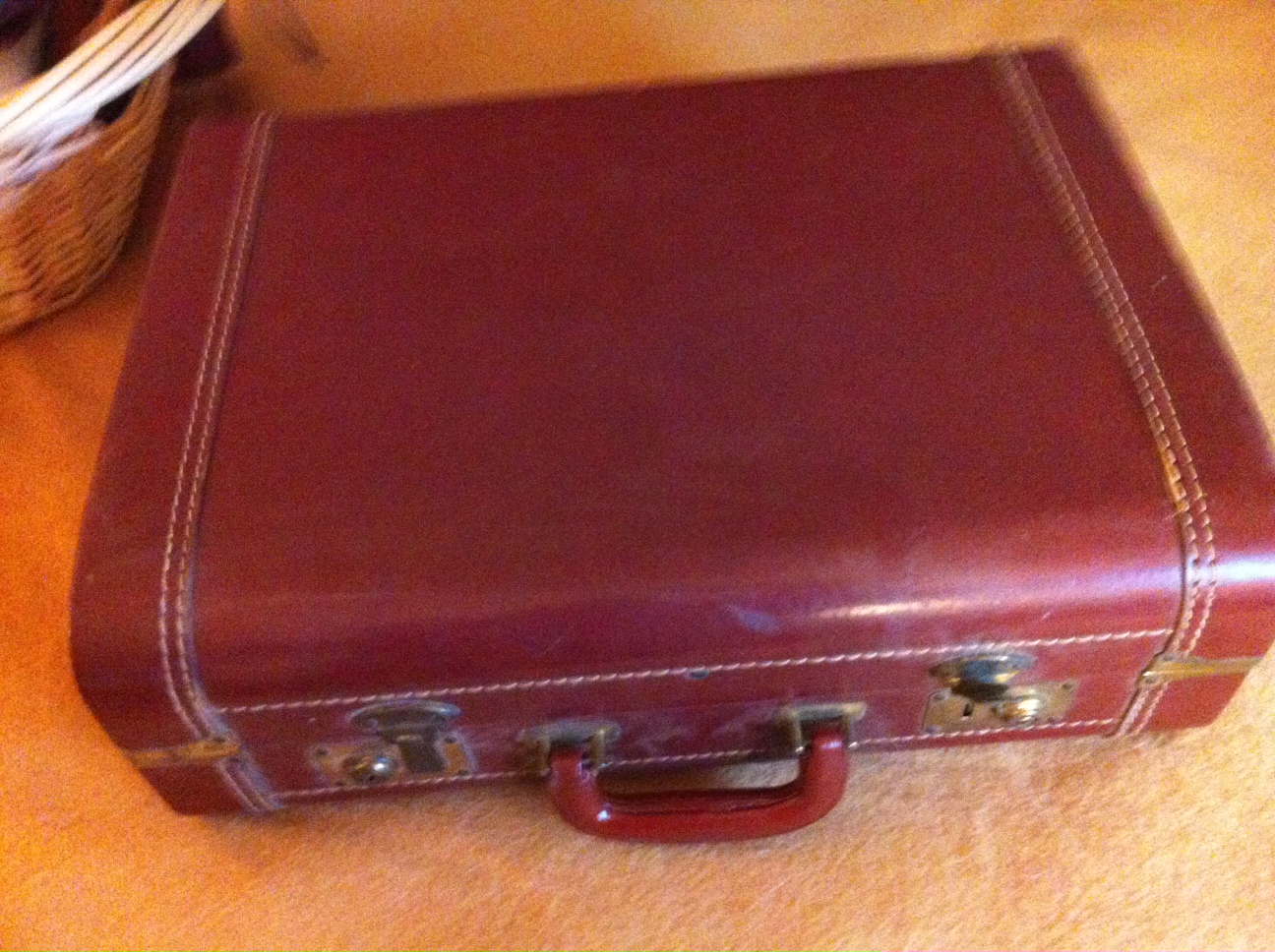
I bumped into it in the throes of a paroxysm of house cleaning and purging back in a dusty corner in my office. It was actually still in the cardboard box it came in. Leather-bound, and still handsome after, what? Maybe 70 years? The scuffs and the sprung latch on the right side are the legacy of my dad’s many train trips to Philly, to Johnstown, to New York and Jersey. It was never really big enough for a week away from home, but it was what he could afford. He had to stuff his things in there and sit on it to close it, which explains the latch.

I wiped the dust off it, and placed it gently on the bed, and Charlie was there with me for a moment. The tears just poured down my face. It was 46 years ago, right around this time of year, and the hurt is still there. He was such a good guy, such a kind and warm man, such a great father, and he was only 54. Why in the name of God did that have to happen?

Almost exactly a year ago, I damn near died. The experience has been transformative, as I guess it is for many people who have had a confrontation with the hereafter. I have spent the last 12 months making some big changes in my life, and I have learned or rediscovered a good many things. I know how much I’m cared for. I know how many calories are in a 12 ounce beer. I know what’s important to me and what is less so. I know how to do a good dead lift and a decent push-up. I have learned to be much happier, with much less. I have learned to be grateful. Maybe the most important lesson, for me at least, has been about time.

I brood on the past. It’s inherent in my profession, in my interests, in my nature. I tend to view current events, both public and personal, through the lens of history. In the last year, I’ve gotten much better at making peace with all that water under the bridge. The value of history is in what it can teach you, not in second-guessing it. What you owe to the dear and departed is your love, not your longing. Your mistakes and misfortunes can be instructive or they can be regrettable, but you get to decide which. In the very short time that we all spend here on this earth, your past can be your inspiration or it can be a short chain that binds you in darkness. As I learned, it can actually kill you.

So I prefer now to look forward. This day, every day, is a gift, a chance to learn, to be kind, to take delight. There are a limited number of them. What I owe myself, what I owe this world, what I owe all the folks who love me and cared for me and saved my life, is my best effort on every one. What will matter when I’m gone is the good I do, the kindness I show, the folks I can teach and help and care for, right now. The tragedies and mistakes of my past can stay there, I don’t have time for them anymore.

What I most want to recall about Charlie isn’t his early death, but him. I remember his laugh, his big voice and his boundless sense of humor, his kindness, his ready willingness to volunteer and to help anyone with anything. I was lucky beyond imagining that I had him in my life.

When I opened Charlie’s suitcase I found it empty, and I closed it again, and I put it away in a safe palace. The tears passed as suddenly as they had come.

I wish you all the Happiest Holidays imaginable…

307