Sunday, August 28, 2016

Rod Number 2


The paste wax needs about 20 minutes to set up, at which point it has jelled into an ugly yellow haze that masks the wood beneath it. Starting with the butt section, I buff away the wax with a soft cloth, and a final transformation reveals itself. The flamed bamboo, previously rubbed with the finest grade of steel wool, and wiped fee of dust with denatured alcohol, has already received 7 very thin coats of pure tung oil. The final buffing of paste wax brings the finish to a golden brown luster, that appears to make the cane translucent. It glows with an internal fire, revealing its structure of supportive and conductive tissue, and the small irregularities of its surface become beauty marks. I have at least 50 hours in this fly rod, and for the most part all I see are the imperfections and mistakes and things I could do better, but right now, in this final revelatory moment, it takes my breath away.

What follows is a succinct description of the making of a cane fly rod, the first one I’ve built completely on my own. Since most of my readers, friends and family don’t fish, I’ll keep it simple and, I hope, instructive and interesting. In the process I will relate what I have learned in the making of the rod, much of which doesn’t have anything to do with fishing poles.

.................................................................................................

Preparing and Splitting the Culm

Not any bamboo will do… For generations now, 12 foot lengths of Tonkin Cane (Arundinaria amabilis McClure) have been imported from a small region of Southern China along the Sui River, north and west of Hong Kong. Tonkin cane is the toughest of the many varieties of bamboo; it’s used in China to build commercial scaffolding. The stuff is heavy and dense and also beautiful as its name suggests (the Latin translates to Lovely Reed). It gets a lot tougher (and darker) when exposed to the flame of a propane torch. The fire drives the residual water from the stick or culm of bamboo. The flaming process also releases the delicious smell of cane into the workshop. The grass family, of which bamboo is a member, also includes sugar cane and sorghum, and the sugar in the wood produces a wonderful aroma of caramel, that is released whenever the culm is exposed to heat or is cut, split or planed. That delicious smell is an integral part of working with cane, and permeates my little workshop. After the cane is flamed and hardened, it’s carefully split with a froe or knife blade. Initially the culm (now sawed into a pair of 6 foot lengths) is split into six more or less equal
strips, then each strip is again split into three or four thinner strips. This is the first of many slow and painstaking processes that will many hours later, produce a fishing rod. It’s deliberate. It takes patience.

…………………………………………………………………………

I’ll be 60 this year. Two years ago I damn near died. I am almost daily reminded now of the proximity of the hereafter and related disasters. The current list of recent dire portents includes encounters with pediatric cancer, a couple of brutal divorces, the loss of a beloved old dog, and other kinds of wreck and ruin within my family and circle of friends. Time presses and the days whirl by with frightening speed. Understand, I’m not running scared. I am a happy man, but I am driven. There is a relaxed urgency in my life that is new and welcome.

Working with cane has been a boon to me in part because it simply does not yield to the rush of impatience. Rod building requires accurate work to tolerances measured in a few thousandths of an inch. Rushing will not help you and speed is not your friend. Patience and focus are required, as is persistence. The urgency I live with now drives me out into the shop at the end of a long work day, but once I’m in there, the need to press yields to the discipline of the cane and the methodical and careful application of the tools to the wonderful and sometimes obstinate material. The sound of rending cane marks the slow passage of the knife through the strip, the sweet smell of bamboo permeates the workshop. Fiddle music drifts quietly from the radio. Time doesn’t stand still, but it slows down some, and that’s enough.

………………………………………………………………………………………………

Selection, Cutting and Straightening, Rough Planing

The 35 or 40-odd strips produced by a split culm are the essence of what will become a fly rod. Most cane rods are hexagonal in cross-section, composed of six strips per section, planed on a 60-degree bevel. The rough strips are sort of flat, crooked, and will always include a number of growth rings called nodes. Analogous to knots in hardwood, the nodes are sections of very tough, but brittle fibers that present all manner of difficulties and challenges to the builder. Strips crack and break easily at the nodes, and they’re never straight. They also protrude a bit from the strip’s outer surface. The rodmaker is always at war with the nodes, down to nearly the final stages of production. A two piece, two tip rod will require 18 strips. A three piece, two tip rod like Number 2, will require 24. This assumes you won’t fuck any of them up in production, and of course, you will. It is also in this early stage that you will select the strips for the rod, and lay them out so that no two strips have any nodes next to each other or within four inches or so of the tip or butt of any section. This insures the rod will have no weak spots prone to breaking and will cast smoothly and behave predictably. When suitable strips are selected, they’re cut to length (usually four inches or so longer than they need to be), numbered, and bundled together by section. Each strip is then carefully evaluated and straightened using a heat gun or alcohol lamp, hand pressure and a vice. In addition, each node is sanded or filed flat on the outside
surface, and planed flat on the inner surface. Finally, each strip is placed in a rough, 60-degree form (mine is an oak board with grooves cut in it with a router) and the planing begins. A small mountain of shavings, and many hours later, one is left with 6 more or less straight strips per rod section that form a hexagon when bound together, but lack the taper of a finished rod section. That will require another form, and more planing. In the next phase of the process, the hexagonal stick will become a fly rod.

…………………………………………………………………………………………………………

The practice of building cane rods connects one to a craft that is almost two centuries old. It’s especially old here in Pennsylvania, where Samuel Phillippe built the earliest strip-built cane rods in Easton during the 1840’s. By the 1870’s, Hiram Leonard’s shop in Maine was producing six-strip bamboo rods that would become models for rodmakers to the present day. Leonard’s shop in turn produced a couple of generations of craftsmen whose fishing rods are famous for their performance and beauty. Among them was Jim Payne, whose dad had worked at Leonard. Jim Payne built rods for decades, many with a distinctive and powerful feel that works well for folks like me who learned to cast with fiberglass and graphite. Rod number 2 is a Jim Payne taper, converted from two to three pieces.

The point is, practitioners of this craft stand on the shoulders and accomplishments of craftsmen (and women) who were at it before our parents or even grandparents were born. My mentors include George Maxwell of Nazareth Pa who started me down the path with a week of instruction in his shop three years ago. Then there’s Bill Taylor, who’s shop was the first one I actually saw with my own eyes and who built the sweet little rod I fish small streams with. Bill Harms, Wayne Cattenach, and especially Jerry Kustich have generously answered my endless questions when I talked with them at various shows and workshops over the years. These guys are, in turn, all connected to their own mentors in places as far apart as Pennsylvania, Michigan, San Francisco and Montana, folks who trace their own lineages back to Leonard and Phillippe. I am, in a slow, halting, still mistake-filled beginner’s way, now a part of this community. The splitting froe, the forms, the block planes, the taper formulas, and all the accoutrements of rod building connect me to a tradition and to a lineage.

You can buy a graphite rod that weighs a fraction of the weight of a cane rod of similar length. It will be cosmetically beautiful and cast like a cannon, and you won’t have to spend weeks waiting for it to materialize. But it won’t be a product of human hands and patience and unbroken tradition and decades of accumulated knowledge.


You can’t buy that.

………………………………………………………………………………………………………

Planing the Taper


Mounted on a two by four atop my workbench is my planning form. I was made for me by a machinist in Colorado, and it’s typical. It’s about five feet long, and composed of a pair of steel bar-stock sections with a 60-degree beveled channel between the two bars. At 5 inch centers there are set screws on each side of the form. By careful use of dial depth gauge and a couple of allen wrenches, the depth of this channel can be manipulated in increments measured in thousandths of inches.

Next to the planing form, laying on its side to protect the blade, is my best block plane. The plane was made by a small tool company in Maine, and cost me an arm and a leg. That’s alright, it was worth it. You can get it as sharp as a razor, it stays sharp, and you can adjust the exposure of the blade in such infinitesimal increments that it can remove shavings that are only a couple thousands of an inch in thickness. These shavings look like dust.

The “actions” of fly rods, that is their behavior as casting tools, are almost completely controlled by their taper from butt to tip. These tapers have been developed by many fine craftsmen and women over the decades. Some have been around since the Leonard shop opened, and they’re still great, some are products of computer-aided-drafting programs and are thoroughly 21st century. They can be surprisingly different from each other. Some tapers are “slow” that is, the rod flexes deeply into the butt and the required casting stroke is deliberate, some are “fast” and these rods can feel very stiff. While fast rods are perhaps less delicate, they can shoot line like a howitzer. There is every graduation of action in between.

The taper is the product of the planing form, the block plane, and very careful and delicate work. The closer you get to the final dimensions, the finer and slower the work becomes, and the more likely you are to bugger something up, especially the very delicate tip sections which may measure something like .032 of an inch. In final planing, there is every chance you will gouge a strip and ruin it: usually because your plane isn’t sharp enough, or because you were in a hurry, or because you didn’t prepare a node carefully enough, or because of some combination of all three. You can be tantalizingly close to the finished rod “blank” ready to be glued and bound with string, and have to go back to the drawing board. Such moments are a test of character.

…………………………………………………………………………………………………………
Anyone who knows me, knows my gregarious nature. I like people. I like to entertain and cook for my friends and family. I’m loud. I like to talk (too much) and play music, and engage my friend, family, and even complete strangers.

Rod building, like writing, is an excruciatingly solitary pursuit. Even in “production” shops like Sweetgrass and Winston in Montana or Thomas and Thomas, where there is lots of collaboration and numerous employees, it’s still often the practitioner, his or her tools, the work at hand, and nothing else in the world. I find the solitary focus and the opportunity to think and act creatively and undisturbed are very good for me. It’s very much like producing essays, scholarly articles, and yes, blog posts.

The solitude and concentrated effort is what keeps me honest. The focus inward counters the somewhat overwrought tendencies of my admittedly large and ego-driven personality. Writing, rod building, fishing and hiking alone: all these things convey the blessing of perspective and reflection. There’s a very Buddhist sense of mindful attention to the moment. It’s good for me…even the occasional solitary blasphemous outburst following a ruined strip, or a bamboo sliver under the fingernail or a cut from a plane-blade.

These loud tirades of colorful language put me in mind of my Dad, Charlie, who was a sweet and charming guy but who could also boil-up with the best of them. The older I get, the more I seem to share with him, and at such boisterous moments I often feel him looking over my shoulder and telling me to calm the fuck down.

I have decided that nothing could please me more.

…………………………………………………………………………………………………………

Gluing, Tuning, Final Cutting, Ferrules and End Stock

This is the real nitty gritty. At this stage the six strips of each rod section are laid out parallel to each other, glue is liberally applied, they are then folded together and bound tightly with thread. Glue being what it is, you have about 20 minutes to pull this off. There ae no do-overs. If you screw up now, you will be throwing the entire section away, all 20 hours or so of it, and starting over.

I have done this.

A couple times.

Assuming you did everything right, the glued and bound sections can be straightened against a flat board or benchtop one flat at a time, and set aside to dry. The glue I use takes about four days to get really solid. When that’s done, the string is pulled off, and the glue that squeezed out of the joints and adhered to the rod surface is carefully sanded away. The rod sections are then checked for measurements at regular intervals, cut to their final length, and checked for straightness. Minor straightening can be done with gentle heat and pressure, and the diameters can be slightly adjusted with a sanding block.

When the rod sections have reached their final dimensions, they go into a lathe. First the butt section is turned down a bit to accept the reel-seat (mine has a European Chestnut barrel, and is machined from nickel-silver). The cork handle will be mounted just above the reel seat. I made my own with ½ inch cork rings, shaping it on the lathe to match the handle of one of my favorite rods.

Then the ferrule stations are turned down. High quality nickel-silver ferrules cost something like 60 bucks a set. They need to fit tight and straight onto the rod, and they must be glued on with very strong adhesives (usually some kind of gun-makers or golf-club makers epoxy), and sometimes a tiny metal pin is inserted through the ferrule and the wood, just in case. This is a high stress location, and if the rod is going to fail, that’s where it will happen. When the ferrules are installed, the male ends (most rods come with a pair of matching tips) will need to be very carefully sanded to final diameter. They come intentionally oversized, and the goal is to very slowly fit them using the finest abrasive paper you can find until they fit snugly into the female side. Not too snugly. It is easy to remove metal from the ferrule, impossible to put it back. If you remove too much, you have to buy a new
ferrule, remove the old one, and do it all again. Again, patience is your friend.

Assuming you make it through these post-planing operations, the rod will now look like a fishing pole, and will be ready for silk and varnish.

………………………………………………………………………………………………………

I have spent my entire adult life outdoors hiking, birding, hunting, and most especially, fishing. I can’t imagine living any other way. That said, I understand that angling is not without consequence. The most beautiful fly rod imaginable, just like a well-made hunting rifle or shotgun, is ultimately an instrument of death. While I release most of the fish I catch, I still kill and eat a few every year. I also know that I stress and cause suffering to those I release. I dislike the mortal consequences of my actions, but I don’t see myself stopping. I’m not sure I can explain that, but I’ll try.

I learned to love the outdoors from my grandfather Giuseppe. He was a bird hunter and he took me along when I was a kid. I loved almost everything about it: the special clothing, the beautiful shotguns, coffee with the older men, the walking, the smell of autumn fields and woods in the early morning. I just hated the killing, and on more than one occasion, it brought me to tears. Grandpop comforted me, and explained that it was good that I disliked the killing. He was a battlefield veteran and had seen and done horrifying things. He hated the killing too. He told me that, should the day come when I came to like the killing, I would have to give up hunting, because my soul would be at stake. He told me that he had met men who liked it, and that they were all monsters.

I was just a kid, and didn’t know what to make of all that, but I think I figured it out.

Suffering and death is the shared lot of all living things. It is the awful price of carnivory, of the pleasures of hunting and fishing, of life itself. There is a place for it between obsession and callousness. It should not drive you from the natural world, which is a place full of deaths of many kinds, but it should never become routine or be inflicted pointlessly. It commands respect.

If you come to respect it, and neither to fear nor like it, mortality can convey blessings. I know where my food comes from. I know how to clean, butcher, and prepare game and fish. I know the almost visceral and ancestral joy of the hunt, the ancient understanding of nature and of our place in it that some of my most distant ancestors knew in their bones. When I choose a fly, stalk a fish, and make a good cast, I do so based on my understanding of the fish’s world. My success or failure helps to define how complete that understanding is. I am not just observing the wild world, I am in it and of it.

I belong there.

………………………………………………………………………………………………………

Finishing and Wraps

The final steps in the process address both beauty and protection. The cane needs a finish that will shed water, and also highlight the grain and surface of the wood. For most rodmakers, this means dipping the rod in spar varnish, then allowing it to dry in some kind of airtight, dust free environment. No such environment exists anywhere on my property, nor do I have space to construct one. A little research led me to pure tung oil. Tung oil is slow to dry and harden, takes time to apply in multiple, thin coats, and produces a matte finish quite unlike the bright sheen of varnish. It is also the most water resistant finish available, having been used for years in nautical applications, and it doesn’t require filtered air and dust free conditions. I conducted some experiments on scrap pieces of bamboo, and found the results quite pleasing. It apparently hasn’t been widely used for cane rods in a long time, but looking at the results I have no idea why.

After the finish has dried, the chromed guides (9 of them plus an agate-lined stripping guide on an eight-foot rod, and a hook keeper, and small decorative wraps to frame the India-ink lettering) must be painstakingly wrapped onto the rod at the proper interval, using silk thread. I chose candy-apple red, tipped with black. The 30-plus half inch wraps take hours of painstaking work, and if you nick one with the single-edge razor blade employed to trim the thread, you have to start the wrap over: a familiar theme in rod building.

My rod is inscribed with my initials, the rod length, number of sections, and line weight, and also the number 2, since it’s my second fly rod. If you make a mistake with the pen and ink, you’ll have a hell of a time correcting it, although it can be done. Trust me I know.

The finished guide wraps are then coated with three coats of thinned spar varnish while being rotated by a slow electric motor. This keeps the wrap varnish from being lumpy and uneven. When the varnish is dry in a few days, the paste wax can be applied, and the rod is ready to fish. That will happen this weekend. I started the process in March. It was worth the wait.

…………………………………………………………………………………………………

These last steps lead naturally to a meditation on the line between craft and art. If you are attentive and patient and exercise your creative and aesthetic senses, a cane rod is an object of substantial beauty. Much like the sculptor’s marble or the painter’s palette, the beauty is already in the material, the artist’s job is revealing it. Rod number two is lovely, but full of errors and compromises, most of which mercifully only I can see. I hope my future efforts will come closer to my vision, and I guess we’ll see about that. For now, it’s pretty enough.

That said, it’s a fishing pole. I know there are folks that buy up high end cane rods, and squirrel them away as investments, or display them in cases. I can’t imagine anything more appalling. This rod doesn’t just look good. It casts smoothly both short and at distance. It is the nicest roll casting fly rod I own. There is strength in it to tire large fish quickly, and its finish will keep water out of the wood for generations. It’s built to be used, scuffed, dropped in mud and sand, jostled around in the hull of a canoe. It should be an integral part of great fish stories. If it’s not, the whole exercise was, for me, pointless.

My friend the blacksmith says there was an 18th century term for what were known as the “mechanical arts”. There were professions that produced aesthetically pleasing objects of great utility. It mattered that the axes, long rifles, copper kettles and other products of these artisans looked good. It also mattered that they worked well and lasted for generations. In a world of mass production and planned obsolescence, this might be the real attraction rod making holds for me. It takes time and patience and the accumulation of skill and tools, and the result is useful and durable and lovely all at once. You will not find one at Walmart.

I am already working on number 3.

Sunday, December 13, 2015

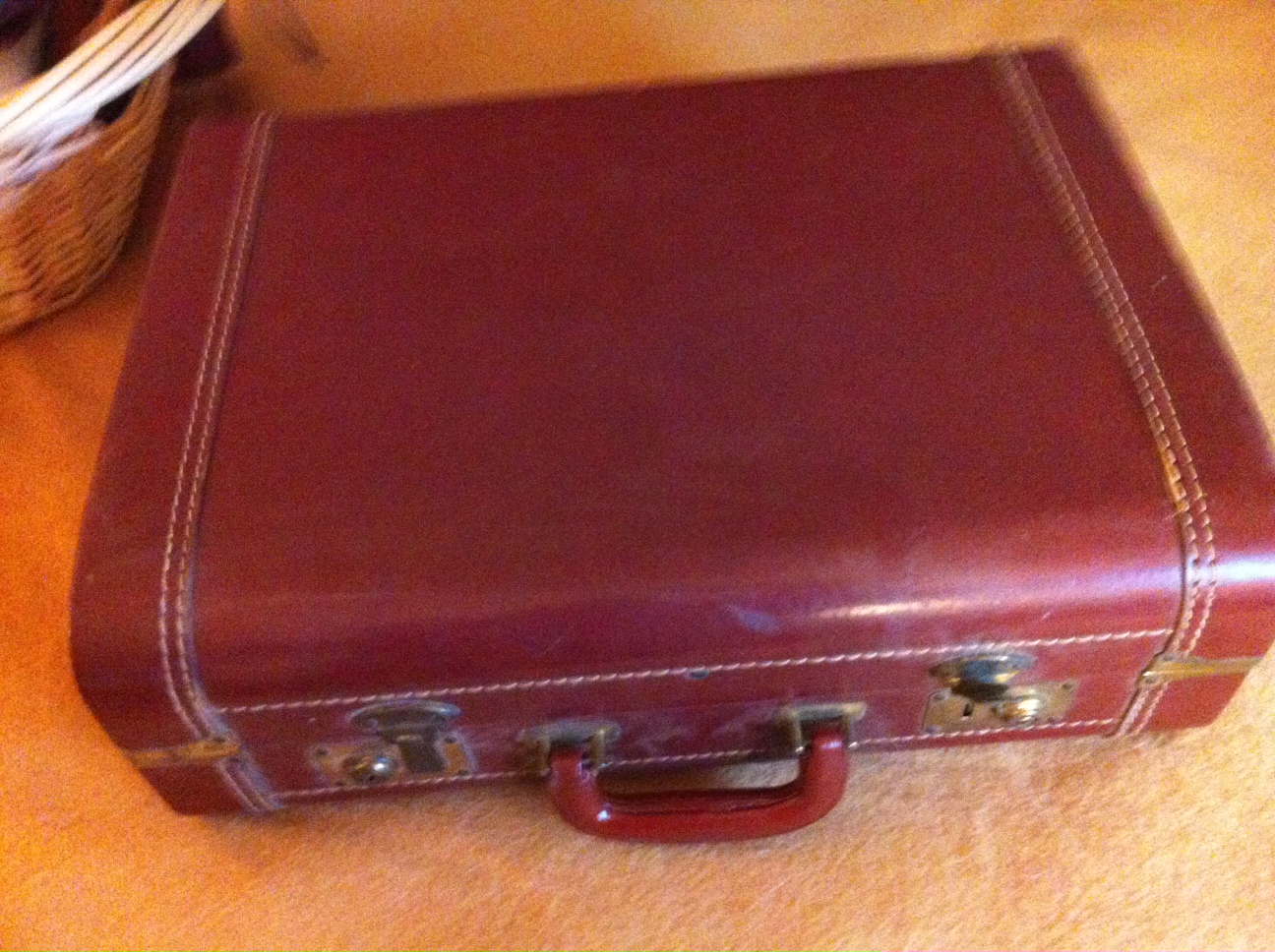
Suitcase


I bumped into it in the throes of a paroxysm of house cleaning and purging back in a dusty corner in my office. It was actually still in the cardboard box it came in. Leather-bound, and still handsome after, what? Maybe 70 years? The scuffs and the sprung latch on the right side are the legacy of my dad’s many train trips to Philly, to Johnstown, to New York and Jersey. It was never really big enough for a week away from home, but it was what he could afford. He had to stuff his things in there and sit on it to close it, which explains the latch.

I wiped the dust off it, and placed it gently on the bed, and Charlie was there with me for a moment. The tears just poured down my face. It was 46 years ago, right around this time of year, and the hurt is still there. He was such a good guy, such a kind and warm man, such a great father, and he was only 54. Why in the name of God did that have to happen?

Almost exactly a year ago, I damn near died. The experience has been transformative, as I guess it is for many people who have had a confrontation with the hereafter. I have spent the last 12 months making some big changes in my life, and I have learned or rediscovered a good many things. I know how much I’m cared for. I know how many calories are in a 12 ounce beer. I know what’s important to me and what is less so. I know how to do a good dead lift and a decent push-up. I have learned to be much happier, with much less. I have learned to be grateful. Maybe the most important lesson, for me at least, has been about time.

I brood on the past. It’s inherent in my profession, in my interests, in my nature. I tend to view current events, both public and personal, through the lens of history. In the last year, I’ve gotten much better at making peace with all that water under the bridge. The value of history is in what it can teach you, not in second-guessing it. What you owe to the dear and departed is your love, not your longing. Your mistakes and misfortunes can be instructive or they can be regrettable, but you get to decide which. In the very short time that we all spend here on this earth, your past can be your inspiration or it can be a short chain that binds you in darkness. As I learned, it can actually kill you.

So I prefer now to look forward. This day, every day, is a gift, a chance to learn, to be kind, to take delight. There are a limited number of them. What I owe myself, what I owe this world, what I owe all the folks who love me and cared for me and saved my life, is my best effort on every one. What will matter when I’m gone is the good I do, the kindness I show, the folks I can teach and help and care for, right now. The tragedies and mistakes of my past can stay there, I don’t have time for them anymore.

What I most want to recall about Charlie isn’t his early death, but him. I remember his laugh, his big voice and his boundless sense of humor, his kindness, his ready willingness to volunteer and to help anyone with anything. I was lucky beyond imagining that I had him in my life.

When I opened Charlie’s suitcase I found it empty, and I closed it again, and I put it away in a safe palace. The tears passed as suddenly as they had come.

I wish you all the Happiest Holidays imaginable…

307

Sunday, August 16, 2015

Montana: A Beginner's Guide


The following story first appeared in a regional literary magazine here in Central Pennsylvania back in the early 2000's. I actually wrote it back in the 90's. I often share it with young friends who are heading west for the first time. Enjoy yourselves...

MARCH: A Long Way from Home

I got on an airplane in Baltimore, at 7:30 AM on a March morning in 1980 to take a seasonal job with one of the large Federal land management agencies that own most of the Northern Rockies. It was foggy and about 50 degrees. I debarked in Butte at about 3:00 PM, where it had warmed all the way up to 15 below zero after a nighttime low of 25 below. After a two hour ride with my new boss, we arrived at a tiny outpost of the Federal Government about 16 miles from the Continental Divide and 12 miles from a town of 200 people. Only the main road was paved in that town, the rest of the streets were gravel. It was ten degrees colder there than it had been in Butte.

The next morning when I opened the blinds on the window of the bunkhouse I was assigned as quarters, there was a coyote standing on a snowdrift maybe 10 feet from the window. He looked up when the blind opened, and we stared at each other through the window for almost half a minute. He was so close I could see his nostrils dilate as he strained to catch my scent. Presently, he cocked a leg in my direction, and trotted away at a dignified pace into a landscape full of gigantic mountains and endless snow. You could see him for almost half an hour, until the white distance simply swallowed him up.

I was 24, and I had never been west of Pittsburgh.

........………………………………………………………………………………………………

APRIL: Regarding Domestic Life

During the first five weeks of my residence, our little combination Ranger Station/Visitor's Center had no visitors. None. Zero. I was busy though. Abe, my boss, and Larry, the maintenance man, both had duties that took them to half a dozen other similar facilities scattered over an area the size of, say, western Connecticut, so most day to day tasks fell to me, the only permanent resident. Since it snowed at least a little nearly every day during those first weeks, I had a fairly predictable schedule that involved plowing the driveway and parking area clear with a small snow plow mounted on a green government truck that was older than I was. After plowing I'd shovel the walks, and sometimes the roof if there was a lot of snow. By then, it would be time to plow the drive and parking area again, and so on....

Actually, I should revise my description of the April visitation rate to no tourists. Local people dropped in from time to time; we had heat and a coffee pot. There were two brothers, twins named Bart and Bob Miller (not their real names), somewhere on the long side of 35 years old, who visited regularly. In many ways they were typical native sons, but they weren't like anybody I'd ever met in Pennsylvania. They didn't seem to actually have jobs per se, yet they were the busiest people I'd ever met.

Between them, they drove the county snow plow and the school bus, they did some logging, primarily for poles and firewood, they built jack-leg fences and Beaver-slide hay derricks and log houses, they dug and cleaned irrigation ditches, they ran some cows of their own and for other folks as well, they bought, sold, and worked on pickup trucks, they guided hunters, they helped to make hay on several of the big ranches in the area. Bob was an amateur veterinarian, farrier, and castrator of calves, which is, evidently, something of an art form. Bart was rumored to have a small still somewhere up on the National Forest that was fired with lodgepole pine, and was said to produce something you could both drink and thin varnish with. As I was an ignorant eastern kid, both brothers felt a sort of moral duty to educate me.

One of the first things you noticed about these guys was their domestic status. In a state where, at least at the time, males outnumbered females about two to one, both of them were married to exceptionally handsome women. Bart's situation was especially odd. Although he was widely known as a reprobate of the first order, his wife, Betty, was a devout Mormon, and they lived under the same roof with her parents and brothers. Her father was a bishop. After I got to know Bart well enough to ask about his and Betty's arrangement, he provided me with the following explanation.

As he told it, they had gone to dinner over in Anaconda a couple of times, and after several such dates, he finally screwed up the fortitude to make a pass at her in the cab of his truck, a pass she responded to with considerable enthusiasm. Before things got too far along, he made a discrete inquiry regarding precautions against pregnancy. She told him she was taking birth control pills.

Now he must have thought it odd that the 20 year old only daughter of a Mormon bishop from a town of 200 people had such a prescription, but he didn't find it odd enough to ask too many questions.

Maybe six weeks later, in the middle of an otherwise quiet Sunday, he answered a knock at his door to find her father and two of her brothers smiling at him through the screen door.

They were dressed for church, scrubbed, shaved, grinning cheerfully from ear to ear, and bristling with firearms. They invited themselves in, and explained to Bart the peculiar and time-honored Mormon belief in posthumous conversion, wherein a sinner, no matter how vile his wickedness, could be saved and brought to know God even after that sinner had actually left the corporal world. The wedding was held a week later in Butte, and Bart was welcomed into the bosom of the family.

"My God, Bart, you must have guessed she wasn't on the up and up!" “Well, yeah, I sorta did, but think about it. I didn't get shot, and they didn't make me convert, so I ain't posthumous or a Goddamned Mormon. I got a good place to live, all the relatives a guy could want and three beautiful kids. Betty is still one of the prettiest women in the whole county, and hell, every mother's son needs to git the dust blowed outta his pickle every once in a while! I think I done OK, depending on how a guy wants to look at things."

Alright, it ain’t Socrates nor Descartes, but it is philosophy, or at least it's philosophical. He and Betty seemed happy enough, and who are we to judge?

...……………………………………………………………………………………………………

MAY: On Independence

To live in the most remote parts of Montana, you have to be able to take care of yourself. If something bad happens to you way back in the pucker brush, nobody is likely to come along and find you, and you might die. It's not that Montanans don't help each other out, most of the ones I know are among the most cooperative and openly friendly people I've ever met anywhere, but in the 1980’s there were only about 800,000 of them. The state is three times the size of Pennsylvania. There's just not a lot of them around.

Bob Miller was sawing down a lodgepole in cold weather during the first week of May, miles back off some Godforsaken logging road on the National Forest. Sometimes if there's a cold snap after the first warm spell of spring, the sap will start flowing in the trees, and then freeze. If you cut a tree in this condition, it may behave unpredictably. The tree slipped off the stump and came straight down, butt first, on Bob's left foot. The whole damned tree. His foot was, of course, broken to pieces. He smoked a cigarette, tightened his boot laces as much as possible, and drove himself 77 miles to the hospital in Anaconda. He did this in a truck with a manual transmission.

Think about that.

In such a place and under such circumstances, independence is not conceptual. It is reality and it is mortal as hell.

....…………………………………………………………………………………………………

The need for self reliance brings with it some other things that make Montana what it is. Hand in hand with independence comes a philosophy that espouses tolerance. The feeling is, if folks demonstrate that they can take care of themselves and aren't bothering anybody, then they have a right to live, think, and act as they see fit. At its best the independent and accepting disposition of Montana has fostered a kind of live and let live tolerance of all kinds of people, a tolerance that has drawn gifted writers, artists, and thinkers to the state and given it a lively and Bohemian creative life completely out of proportion to its tiny population and distance from the big coastal centers of the arts. At its worst, this is the same tolerance that has allowed the Freemen, and other less well known groups of hateful people, to flourish, the same acceptance that allowed Ted Kaczynski to live a quiet life near Lincoln for years without anyone ever wondering or asking what the hell he was up to. Montana is a monument to both the possibilities and pitfalls of absolute personal freedom, a paradox that most Montanans recognize and try to come to terms with.

…………………………………………………………………………………………………

Bob Miller made it to the hospital, and the doctors pinned his foot together, put a huge fiberglass cast around it, and managed to save it. Two weeks later, he drove back to the scene of the injury, wrapped a plastic bag around his cast, got out his chainsaw and buzzed up the lodgepole that smashed his foot. When he got the pieces home, he split them up for cordwood. …………………………………………………………………………………………………

JUNE: The Arsenal of Democracy


In the early 1980's there weren't a lot of satellite dishes or TV cable companies in the most rural parts of the Intermountain West, so where I lived, real-time broadcast news of the outside world mostly came by way of a powerful AM radio station out of Butte. The music they played was awful and no one ever turned it on. Thus many of us out in the hinterlands were mighty surprised that early June day when the sky got just about pitch black at noon time, and a fine gray substance began to rain down on us. Of course we all assumed a nuclear exchange had occurred.

There were lots of documentaries in those days about the impending nuclear crisis, and Montana, thanks to its low population density and abundance of federal land, contains uncountable ICBM silos. The thinking in Washington is, by locating the nukes in the western boonies, you minimize the "incidental losses" if your "assets" are "targeted". What this Washington-speak actually means is, in the event of a nuclear war, the deadest people will be in Montana, Idaho, Utah, Nevada, Wyoming and the eastern parts of Washington and Oregon. Bart Miller's response to all of this was to stop his truck as often as possible at the chain link gates of any silo he happened to come upon in his travels, and take a leak in full view of the silent but watchful camera that stood sentinel at the entrance. I have always assumed his FBI file to be quite entertaining and extensive.

……………………………………………………………………………………………………

There is a deep resentment of the Federal Government throughout the Rocky Mountain States, a resentment no easterner can truly appreciate. Their populations are low so they have little influence in Washington. The federal government is generally the biggest landowner in the state, doesn't pay taxes, doesn't have to obey local and state ordinances and laws, and most local folks depend on it for lumber, firewood, game, fish, grazing, jobs, minerals, irrigation and drinking water, and other things. Most Rocky Mountain natives feel like they should have some considerable say in how Federal Land gets used, since its use affects them dramatically and disproportionately. For better or worse, Uncle Sam has assumed the role of a hated absentee landlord in much of the west, and using the region as a place to stockpile weapons of mass destruction and toxic waste, as if nobody lives there, hasn't helped matters.

Of course, the "sagebrush rebellion" and "wise use" types, who simply want carte blanche to do whatever the hell they want to with Federal Land, and have been threatening to shoot at Federal Employees lately, aren't much of an alternative to a monolithic Big Brother. Mining-caused Superfund sites, 3600 acre clearcuts, severe overgrazing, and the de-watering of entire drainages have been some of the by-products of Federal acquiescence to local demands. This acquiescence has been generally lubricated by the none-too-subtle bullying of extractive industries and the elected officials from the region whose campaign chests are subsidized by these industries. Like it or not, there's no good evidence that local people and business interests manage land or resources any better than the "faceless bureaucrats".

What is needed in Montana, and all over the Intermountain West, is a better way to manage public land; a paradigm that responds to local interests and national priorities in something like a balanced way, and does so with a little grace and respect for the land and the folks who manage it, and live near it.

………………………………………………………………………………………………

To the relief of all in the vicinity, the gray stuff proved to be a stray volcanic ash cloud from Mount Saint Helens, and harmless. After several hours of nail-biting uncertainty, I joined quite a group of folks decompressing from the scare in the local gin mill. Bob Miller, deep in his cups, stood up at the table, stomped his huge cast on the floor to get everyone's attention, and roared out his contention that Montana should secede from the Union. His embarrassed wife Joanne tugged on his arm trying to get him to sit down, and hissed "Christ Bob, shut up! You're drunk. We can't win a civil war!" Bob glared at her, weaving a bit and struggling to balance and focus, "Why not? We got all their goddamned missiles!"

…………………………………………………………………………………………………

JULY: Ignorance and Enlightenment


In early summer, I was joined by another seasonal employee, inflating our full-time staff to two, and bringing another kid from "back east" to the mountains. George Nylund (again a pseudonym) was from Minnesota, which to many Montanans is "Back East", and was, like me, in his early 20's. As it turned out, he had even more to learn than I did.

George drove straight through from Duluth to start his job, about 26 hours, and ate a lot of junk food on the ride. Consequently, his first week in paradise found him suffering from a quiet but uncomfortable intestinal disorder that sent him to a doctor in Anaconda on his first day off. When he got back, I made a delicate inquiry regarding the results of his visit and the state of his health. He said "I'll be fine. The doctor gave me a prescription for some suppositories". This was more information than I was really looking for, so I dropped the subject.

Two mornings later, I had a day off and George had to work. I was lounging in my bunk, and rolled over, opened my eyes, and began my day with the sight of George, shaving in his underwear, framed in the open bathroom door (ah, the romance of government housing). As I began toying with the notion of getting up and making coffee, I was horrified to see George, with the door still open, reach for his brown prescription bottle and extract from it a foil wrapped "silver bullet" of considerable diameter. I was on the point of screaming at him to shut the door, but before I could, he peeled off the foil wrapper, put the immense lozenge in his mouth, and choked it down with a large glass of water!


“George!" I shrieked "That's a suppository!"

"I know, the Doctor prescribed them for me."

"George! Do you know what a suppository is?"

"Yeah it's for constipation!"

An innocent! He had no idea.

"George! You're not supposed to swallow those Goddamned things!"

"What do you mean? What am I supposed to do with them?"

A fair question. When I answered it he, of course, assumed I was trying to play a disgusting practical joke on him. We had a ferocious argument that ended with the two of us standing together in the kitchen in our underwear, literally a half inch away from fisticuffs, looking at the entry for "suppository" in Webster's Collegiate. "You see that you fucking idiot, it says 'rectum'! Do you know where your rectum is?"

He went white as a sheet, called the doctor's office immediately, and asked if he had been poisoning himself. The doctor launched into a howl of laughter so loud I could hear it clear across the bunkhouse. When he calmed down, he told George they were just gelatin capsules full of glycerin, and essentially inert. George composed himself, shot me a murderous look and told me that if I breathed a word about what had happened, he'd kill me. I couldn't help it though, and I told Bart Miller that afternoon in the mercantile. By evening, George was known across the entire county as "Wrong End Nylund", a name that stuck until his appointment ended in the fall. He is locally famous to this day.

....................…………………………………………………………………………………

AUGUST: A Fish Story


To the sportsman, Montana is a prodigal place. I came west from what is, arguably, the best trout fishing state in the East. I’d been a pretty dedicated fisherman since high school, and I knew how to do some business with a fly rod. At least I thought I did.

When Bob Miller found out I liked to fish, and had been catching a few nice brook trout in the little creek behind the station, he graced me with a hot tip. "The real nice ones are actually back in the beaver ponds, just east of where you've been fishin." "What's 'real nice' Bob?" "Well, I seen a few fish come out of there over 20 inches." Where I was raised, a brookie of 12 inches is a monster, and even taking into account the propensity for fiction common to all fishermen, Bob had me salivating. I didn't ask for any suggestions on fly patterns or tactics from Bob, since both he and his brother employed coarser methods than I was used to. When they felt like a little relaxation, they used worms or live grasshoppers fished on an old fly rod, like most local folks. There was also talk of Bart supplying the fixings for the big Miller family picnic and fish fry by plumbing the depth of a nearby lake with a quarter stick of dynamite. This technique, colloquially referred to as employing the “Dupont Coachman” fly pattern, was not something I had ever heard of back home, and Bart would neither confirm nor deny his expertise with it.

I'd never been in the beaver ponds before. They turned out to be full of mosquitoes, moose, and, based on the tracks, the odd grizzly, and were a perfect maze of channels, dams, ponds, meadows, and swamps. It was slow going and scary as hell. I stopped at what looked like a good spot at a breast high dam that held back a pond of perhaps an acre. I made a cast into the pond with a small deer hair dry fly affixed to a tippet of five pound test monofilament, a rig I often employed in eastern waters. There was boil at the fly that looked like someone had flushed a toilet out in the beaverpond, my rod bucked over double, and the fly instantly parted from the tippet with an audible "ping". I was left standing atop the beaverdam with line wrapped around my head, my eyes wide as saucers, and my knees knocking together, mumbling cusswords to myself. Later that evening I learned that the technical local angling term for this condition is "having your knickers up in a knot".

………………………………………………………………………………………………………

As it turned out, I wound up living in Montana for seven years, and spent more time fishing than I probably should have. I return to fish and backpack nearly every year. I can't really say if the fishing is any better or worse than it "used to be", but it's different, I watched it change. Not long ago my brother-in-law called to tell me that he'd been looking at a People magazine at the barber shop and had read that fly fishing, a pursuit I've enjoyed since I was a teenager, was the number one trendy sport in the country. He had called me right away to tell me "You're so out of it, you're actually back in!" Of course this popularity has affected Montana's stupendous trout fishery in some fundamental ways.

While I wasn't in Montana for the "good old days" whenever that was, I can remember fishing the Madison, Yellowstone, Big Hole, Clark Fork, Bitterroot, and Kootenai rivers in the early 1980's, covering lots of water, catching sometimes obscene numbers of big trout, and often not seeing anyone all day. That doesn't happen anymore. The simple, impressionistic flies that used to work well have been replaced by much more exact copies of insects and baitfish, because many fish have been fooled by feathered hooks before, and they are more careful. People from California, Texas, and Back East have bought up and posted river frontage, especially in southwestern Montana, and eliminated public access to long stretches of some streams, hoarding the fishing for themselves, and turning what used to be working ranches into effete and nasty little "ranchettes".

These same newcomers have thrown their money and time at preservation of in-stream water flows, fighting whirling disease in the rainbow trout population, habitat restoration and preservation, and many other good things. Unlike many traditional Montana fishermen, they also tend to release most of their fish and to catch them with barbless hooks. All in all, maybe the good and bad effects on the "Big Name" rivers cancel each other out; the fishery remains healthy or even improved, but you share it with more folks.

………………………………………………………………………………………………………

I returned to the beaver ponds the next evening armed with a much heavier tippet and, at the suggestion of my boss, some huge, gaudy, and delightfully old fashioned Potts “Mite” series wet flies. These native Montana patterns have collars woven from coarse hair, and are both seductive looking in the water and nearly indestructible. I had never used such flies and had no confidence in them, but they worked great. Over the next few weeks, I took several brook trout from those ponds that might have weighed three or even four pounds, real monsters, and even ate a couple. Their meat was pink like salmon, and just as delicious. Once, near the end of August, I was talking with Bob Miller in the station when a tourist walked in and asked me if the little creek and beaver ponds he'd passed driving up had any fish in them. I paused for a second and said "Just little ones and a few whitefish". When he left, Bob stared at me in mild surprise. "Damn, you're turnin into a real local ain't ya!"

……………………………………………………………………………………………………

SEPTEMBER: Exodus


Abe let me know during the first week of the month that I'd be laid off in four weeks, and George went home the next week, leaving me the sole proprietor for the end of the season. One morning there was snow on the ridgeline above the Ranger Station, and for the first time in my life I heard elk bugling. The weather was beautiful those last few weeks, and the fishing was very good, but I was restless. Back in March and April, when I was plowing and shoveling snow, all I thought about was going home. Now I felt different.

I had learned so much in such a short time, as will happen when you're in your early 20's and don't know much to begin with. I had learned how to saw down and buck up a lodgepole without killing myself or anyone else. I learned how to properly cook a big brook trout. I learned how to saddle, ride, and be thrown from a horse. I learned what mountain oysters are, and that they make me sick. I learned how to roll my own cigarettes, and drink Rainier Beer. I learned that when you ask a girl from a town of 200 people to take a drive to Butte or Missoula with you, pretty much everyone knows about it by evening. I learned what Blue Healer dogs and Hereford cattle are. I learned to play shake-a-day with Fatty the barkeep. And I learned to love Montana.

……………………………………………………………………………………………………

I ran out of work in October, and after having an end of the season dinner and debauch with the Miller twins and their spouses, I drove home to Pennsylvania in a used Ford pickup I bought over in Anaconda. It was cheap, but it needed work and would barely make 60 miles an hour. Consequently, the ride took almost five days, and I had lots of time to think. I thought that I had maybe seen the Promised Land, and like Moses, I was grateful for that. Over the tapping of the valves and the roaring from the rust hole in the muffler, I wondered if I would ever get back there.

311