Copyright 2023
Joe Baker, Boiling Springs
A note to the reader…

school. The very thought of it filled me with shame and terror, and it still does.
I changed my mind in part because I listened to an interview with the writer and advocate Virginia Sole-Smith, some of which rang very true with me, and some of which made me angry. Her podcast and newsletter Burnt Toast are also worth paying attention to.
I also changed my mind because I’ve come to believe piping up might help me, and it might help you too.
The discomfort on my part comes from the essential requirements of good writing in the personal essay form. The good stuff, the stuff worth writing and reading, demands the writer lay his or her cards on the table, face up, in plain sight. At the same time, the good stuff also demands that the heart of the story isn’t really about the writer. Rather, it has to be about something: something bigger. The challenge is facing down the undeniable truth that the path to that bigger thing lies squarely through your own heart, and other people are going to see it.
And that can take guts.
Understand, I’m basically a stodgy old man, so there will always be a part of me that thinks this is not your fucking business. My desire to be a kind and good man overcomes this, but just barely.
So I entrust this to y’all. I release it like a bird caged for a very long time. Let’s see if it can fly.
JB, Boiling Springs
Summer, 2023
The Knee
In the late summer of 2021, I took a nasty fall in my garden and separated my shoulder. I was alone at home when it happened, and I had a hell of a time simply getting up. A friend discovered me sitting on my deck with an ice bag on my shoulder, both knees bleeding, and in substantial pain.
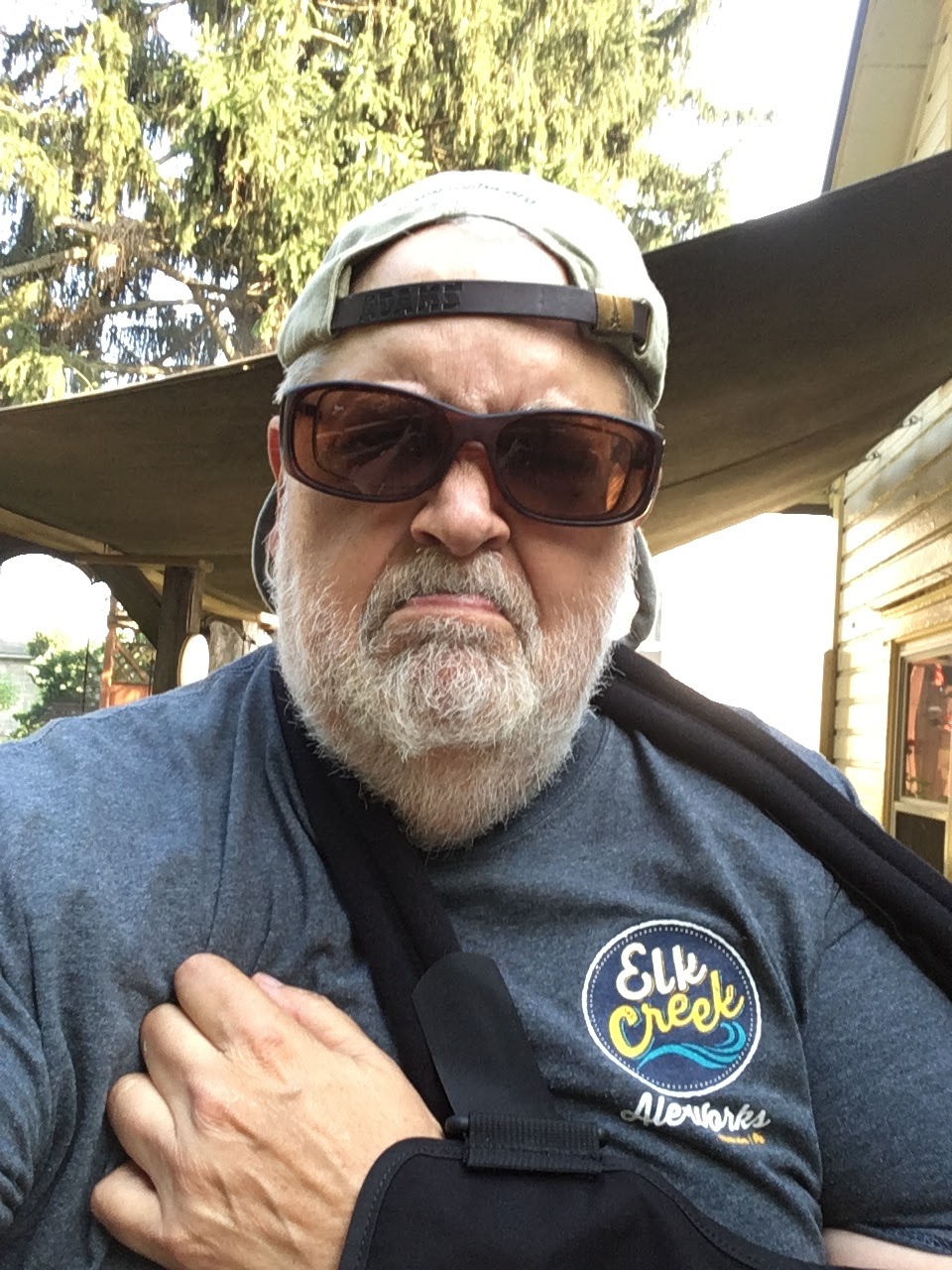
Following x-rays, an MRI, and a visit to an orthopedic clinic, the news about the shoulder was tolerable. It popped out of joint, but popped right back in. The rotator cuff, while plenty sore, wasn’t torn, so surgery wasn’t required. At least shoulder surgery wasn’t required.
The fall was caused by my utterly ruined arthritic left knee. The joint had been deteriorating for over a decade and was now just bone-on-bone. I took a powerful prescription anti-inflammatory drug daily just to be able to function. As a surgeon explained, the excess motion and instability of the joint had stretched the supporting ligaments to the point where they didn’t work very well. As a result, I was never sure if the joint would support my 360-pound body when I put a load on it, and on that fateful August afternoon, it did not. Given the potential for something much more serious than a shoulder sprain, something had to be done.
But the knee replacement I needed wasn’t going to happen anytime soon. A surgeon told me that before he’d even consider conducting the procedure, I would have to lose at least 50 pounds. He recommended bariatric surgery and booted me out the door. It was the sort of dismissive and shitty brush-off lots of fat folks get. Having struggled with obesity most of my life, you’d think I’d be used to it, but I’m not.
Bariatric surgery didn’t interest me. Neither did appetite suppressing medications. In part that was due to the suite of side effects and risks that come with each, and in part it came from experience. At 64 years old, I’d lost more than 100 pounds three times in my life. I did it all three times with a combination of exercise, a balanced and restricted diet, and medical monitoring.
It goes without saying that I also gained more than 100 pounds a corresponding three times. We’ll get to that, but the point is: I knew I could lose the weight, and I knew how to do it.
I also knew I would need help. My late and very dear GP of more than 20 years helped walk me through two earlier weight loss episodes, and he made it clear that help was essential, because eating disorders are the most difficult of all addictive behaviors to treat. As he told me, when a patient confesses to a drug addiction or alcoholism, the first and most obvious treatment is to empty the house of dope or booze.
But you have to eat, every day.
Empirically, there are a wide variety of ways to successfully and safely reduce your body weight. Weight Watchers, Noom, surgery, medications, high protein diets, macrobiotic diets, vegan diets, vegetarian diets, Paleo diets, you name it…they all can work. There is, however, one thing that I think all successful weight loss programs have in common: at some regular interval, weekly, bi-weekly, whatever, you have to stand on a reasonably accurate scale in front of someone to whom you are not related, and who does not love you. It’s also helpful if you’re paying that person for expertise and sound advice. For me, and I think for nearly everyone, external accountability is a critical component. Weight reduction isn’t all straight ahead biology: most of it’s between your ears.
Following a health crisis and a near-death experience in late 2014, as will happen to a 400-pound man, I had started working out two to three days a week at a local gym and restricted my diet. I shed nearly 100 pounds in the process, but I couldn’t sustain the effort, and I had gained 50 of them back. I did continue my training regimen at the gym, and that’s where I met my first guru. Chris was a recently hired trainer at the gym, and he specialized in weight management. He’s the age of many of my interns. One lesson I learned from decades of managing interns and young seasonal employees was the value of keeping my mouth shut and listening to young folks. This does not come easily to me. I like to run the show and I like to talk (ask anybody). But if you shut up, swallow your ego, and abandon some assumptions, kids can sometimes teach you as much as you can teach them.
Chris turned out to be that kind of young person. He’s smart, kind, quiet and patient and he knows what he’s talking about. His university training and his demeanor prepared him well for walking old farts through the process, and we hit it off well. We looked at what I was eating and identified the problems pretty quickly.
My blessing and my curse are the same: I’m a good cook. I’m a first-generation American from an Italian immigrant family. I like to prepare good, healthy food, and I know how to do it. Processed and fast food don’t do anything for me. The blessing is eating well, the curse is liking it too much. I didn’t change the food I ate very much at all. Instead, I reduced the portions (and eventually the frequency), and I eliminated snacking. I was able to do this by paying attention, and Chris had a neat little trick that helped me.
Prior to eating anything, he asked me to snap a quick image of it, and text it to him. The purpose was not to allow him to judge me or to reply with a punitive message of some kind. To my knowledge, a year and a half into it, Chris has never responded to these images with anything but support and good humor. The purpose of the photography was simply to impose a brief pause on me before I ate or drank anything. That little pause allows me to consider and notice the food on my plate. Attentiveness prevents the possibility of thoughtless eating. It makes me aware of what and how I am eating. It works, and it turns out attentiveness has applications well beyond food. We’ll get to that too…
Hand in glove with the restricted food consumption, was physical training. This included strength training focused mostly on my core. It also included aerobic exercise, in my case walking miles on my ruined knee with hiking poles on a graveled path in my local park system. As Chris taught me, successful weight reduction is probably 85% controlling and limiting your caloric intake. The remaining 15% is aerobic and strength-focused exercise. That 15% is, however, absolutely essential. As muscle mass and endurance slowly and steadily increase, the body’s baseline need for calories (the Basal Metabolic Rate or BMR) goes up. It can also temporarily reduce hunger, and it releases endorphins that help you weather the psychological challenges.
In the late fall of 2021, the transformation began. Weekly weigh-ins documented a steady decline of perhaps a couple pounds a week. The measurable success encouraged me, and the descending regression line on the spreadsheet I used to record my progress made the self-denial and sacrifice bearable. By May of 2022, the necessary 50 pounds had melted off, and I scheduled a consultation with a new orthopedic surgeon, this one with more social skills. A date for the knee surgery was scheduled for the fall, and I took pride in my success.
And in June, some quite remarkable things occurred, and everything changed.
Father’s Day
Mark Twain said, “The two most important days in your life are the day you are born and the day you find out why."
In my case that second day was more like a week, but I did find out.
…………………………………………………………………………
On June 17th, a Friday, I went for a two mile walk with some things on my mind. I lost my dad, Charlie, when I was 13, and it was a big death. He was a good man, and I loved him. His birthday was the 17th, and frequently fell on Father’s Day. He often jokingly complained about getting stiffed since the celebrations were usually combined in our family.

So I walked along with Charlie’s ghost still over my shoulder all these years later. I am of course used to it by now, but I still feel it. As I neared the end of my walk, I remember thinking, and may have even said out loud, “Boy, I could use a hug.” My phone rang. It was a young friend of mine. He was the manager of the little nature preserve I was walking in. He told me he’d seen my car at the parking lot and asked me if I could stop by the small nursery he cared for tucked in an out of the way corner of the preserve. I agreed and drove the short distance to the nursery.
As I pulled in, I found his car parked at the end of the road, but there didn’t seem to be anyone around. I got out and looked around, and then I saw him, accompanied by his wife and a co-worker, walking up a path toward me. He stopped in front of me, looked me in the eye, and said “I just got fired 15 minutes ago.” He teared up, and began to heave and sob, and I just tackled him, bear hugged him, and hung on for dear life. The 20-something couple had just closed on a house the previous week. He loved his job and poured his heart and soul into it. A change in management and a variety of personal conflicts had led to his termination. He was, in that moment, utterly bereft. He’s a good kid. I hung on tight until the worst of it passed then I held him at arm’s length and told him he was a good man and that things would work out and that I was proud of him. As I drove away 20 minutes later, I remember thinking “Well, you got your fucking hug.”
The next morning, the phone rang, and a dear friend and neighbor informed me that her sweet and decrepit old dog had passed in her sleep during the night. A couple friends and I formed a burial detail. We spent all morning excavating a sizeable grave (the departed poochie was a good-sized Samoyed) and we laid her to rest in a treeline on her owner’s property. We went out to dinner that evening and we all did our best to console the bereaved. Following the previous day’s encounter at the preserve, I began to think the universe had it in for my circle of friends. And maybe it did.

young people I mentored at some point in their lives. I’m still in touch with a lot of them. On Father’s Day morning, as I sipped my coffee, I came across an on-line article about a technical subject that I knew one former intern of mine who lives in Hawaii would be really interested in. I sent him the link in a text message. When I sent it, it was probably about 4:00 AM in Honolulu.
My phone rang. My former intern was on the line. He’s as good a young man and as kind and decent a person as I’ve ever met. His brother, only a year older than him and his only sibling, had just died very suddenly. He was in shock, his folks were beside themselves. We talked for a long time. I did my best to calm and console him and slowly walk him off the ledge of tragedy as best I could. It took a while, but we got there. By the time the call ended, I was completely emotionally spent and overwhelmed by all the trouble in this old world.
And then the phone rang again.
This time it was another former intern calling more or less out of the blue. She’s a wonderful person and a great and accomplished professional who has begun mentoring and teaching her own interns and young employees. We’re really close because we’re a lot alike in some ways. She asked,
“How ya doin?”
“Just OK, been a crazy weekend so far. You?”
“Just fine. So, I was thinkin about you this morning.”
“Yeah?”
“Yeah! And, well, I hope you don’t think this is weird, or anything, but, um, well…”
“Spit it out!”
“Well, I wanted to wish you a Happy Father’s Day.”
Now, I’m childless. When I was young, I didn’t think I wanted kids, and by the time I thought otherwise, it was too late. She just took my breath away. I wept big, hot tears of gratitude for a long, long time.
Fuckin kids…
I thought about that weekend for the next few days.
I thought about the circle of family and friends and mentees that surround me. I thought about how much I was needed and relied upon, and how much I was loved. I thought that at 65 years old, I wanted to stick around and bask in it for as long as I could. I thought that I could do a lot of good for a lot of people in this world and maybe pay these wonderful folks back for all that love and trust and honest decency. I thought I owed them and owed myself my very best.
I also thought that gaining and losing 100 pounds four times in one life is abnormal and symptomatic of much bigger things. I thought that sorrow and sadness and fear and depression had dogged me much of my life, and that I didn’t want to live with it anymore.
It was a big, damned jolt.
Now I think most of the epiphanies I’ve heard about were the product of an overwrought imagination and an underwrought intellect, and I confess to plenty of cynicism and snark about all this, but this really was a lightening stroke, much like a big love affair.
Over the next couple weeks, I tentatively reached out to a few people I’m close to and asked them what they thought. This was itself a big act of courage for me. In the era I grew up, men were raised to be laconic and to keep their troubles and thoughts to themselves. In every case, I was rewarded. I was made to understand I was beloved, relied upon, indispensable. I got a hug so tight from one former intern I thought my head would pop off.
Fuckin kids…
It seemed I had a purpose.
CBT
In early July, I began to seek counseling for depression and an eating disorder. The first challenge was simply getting in a door somewhere. One of the absolutely worst aspects of our wretched health care system in the US is access to preventative health care of all kinds, including psychological counseling, weight management, and virtually any other care focused on preserving and maintaining health. I am privileged to have excellent health insurance, lots of experience navigating the health care system, all of my faculties, reliable transportation, a comfortable income, and a post-graduate education, and it took me until November to get an appointment. Had I been in crisis or suicidal, I could have gone to an emergency department and been seen immediately, but trying to avoid sinking to those depths was nothing but hurdles. Those hurdles are a product of political influence, greed, and the worst kind of cynical disregard for the well-being of others, a disregard that is now fashionable and rampant in this country. The American system actually runs on and depends upon a plentiful supply of the sick and suffering. There is simply no profit in healthy people.
The journey to get in the door of a reputable practice required innumerable phone contacts and emails, interminable searches on-line, a referral from my GP, and endless patience. While I waited, I continued to focus on my physical health and on educating myself on the effects of emotional trauma, eating disorders, and the many paths to overcome these things. There was a lot of stuff to think about, and a lot of it wasn’t much fun, but as I focused on my upcoming surgery date in the fall, on educating myself, and on simply trying to be in all ways healthy, things began to evolve in a new way. As I was about to find out, the rugged and grinding path to successful weight reduction shares substantial mileage with the path to mental health.
I finally got to meet my second guru a couple weeks before my knee replacement. By that point I was 80 pounds lighter than I’d been about a year earlier. I’d never spoken to anyone about my mental health before, and it sure as hell wasn’t easy. Fortunately, by dumb luck, I found the right guy. He’s a 50-something PhD, an empiricist much like me, and he somehow made it through a rigorous academic regimen and a long career counseling the heartbroken, addicted, and hurting with an intact sense of humor. Opening up was still hard, but he made it as easy as it could be. He also opened the door to the realities and character of modern mental health care.
For the last quarter century or so, most mental health counseling has focused on a careful, methodical, and rational process of self-examination known as Cognitive Behavioral Therapy, or CBT. The couch is still there, but Dr Freud is not…nobody is going to ask you if you are lusting after your mother or father (unless, I suppose, you actually are).
CBT posits that our emotional and physical reactions to stimulus, to occurrences, to other humans, to situations, all pass through the filter of our own perceptions of reality. How we feel and what we do depends on how we see the world. How we see the world is largely a product of things we learned and things that happened to us in our past, especially in childhood. Some of these lessons were explicit, some were learned by observation, and some came from pleasurable or traumatic experiences. They constitute our internal narrative: who we are and what happened to us. These perceptions can be accurate and healthy, poisonous and completely false, or somewhere in between. Modern psychological counseling focuses on a careful examination of our own perceptions of reality, and it does this through regular journaling and regular discussions with a trained clinician. The above is a greatly simplified description of what can be an enormously complex process. If you want to know more about this, there’s some resources at the end of this essay that should help.
My own journey through this process (9 months and counting) has taught me a great many useful things. Among the most important, in no particular order, are:
- The simple act of frequent and regular introspective journaling following a prescribed structure is routine. It is habit. In this sense, psychological and physical change for the good are much alike. Indeed, they’re inseparable. Simply put, good habits replace bad ones.
- Many folks who struggle with depression fall prey to addiction, because feeding the addiction is pleasurable and a relief from misery. In my case it’s binge eating. Again, it’s the most difficult addiction to overcome, since you can live a long and happy life without drugs, alcohol, tobacco, gambling, etc., but not without food. Further complicating matters is the shame and prejudice fat folks deal with every day. That shame and prejudice is traumatic, especially for kids, and each trauma invites more binging, and more binging makes you fatter, and more fat brings more trauma, and so on. It’s quite literally, a death spiral. I’ll spare you the details. Every fat person, indeed, every victim of any kind of shame, bigotry, and prejudice, has a story. All of them are ghastly.
- Addicts hurt themselves, and also other people. You can become so full of anger, self-loathing, dishonesty, fear, and sorrow, it can blow up nearly every good thing in your life. When you most need love and support, you can drive it away. Addiction and depression create a bleak landscape of loss and pain, most of it self-created. Nobody should inhabit that landscape, but lots of us do.
- No one asks for or deserves trauma or injury. The universe is random, and trouble falls out of the sky. It lands on everyone at some point or another. We are adaptively programmed to expect, notice, dwell on, and anticipate trouble and misfortune. That evolutionary programming helps keep us alive and prepared for the worst. What is much harder for all of us to do is appreciate and notice the many good things in each of our lives. Love, kindness, lucky breaks, great opportunities, beauty, grace, can all be taken for granted or even missed entirely.
- Attentiveness is key to a better and healthier life. Noticing what you’re eating and what you’re not. Noticing the good as well as the bad. Noticing changes large and small. Noticing your mood and emotions, and the moods and emotions of those around you. Noticing the moment in lieu of anticipation or of reverie. Listening. Silence. A quiet and calm mindfulness of the world within and without is always your friend.
- Everyone’s regimen is different. I have opted to go without anti-depressant drugs or appetite suppressants, and I have opted not to undergo bariatric surgery. To date I’ve been successful without these things. Other folks may need all three to succeed, and maybe I will someday. That’s perfectly fine. People who have successfully used medications and/or undergone surgery will tell you that they also had to develop a routine and commit themselves to change, and that it was a lot of work. The important thing is finding your own path.
- I am as irreligious an old pirate as you will ever meet, but I do know people whose path to a happier life has been guided in part by their faith. I will say that my own practice includes meditation nearly every day, in part because it clears my mind and forces me to live for at least a short time in the actual present moment. I had a discussion about this with a devout friend and walked away thinking that prayer and meditation share a lot of common ground. CBT shares a certain amount of real estate with Stoic philosophy and Buddhist thought and some aspects of many religious and philosophical traditions that have been around for millennia. There is nothing new under the sun.
I’m pretty damned sorry I waited until I was 66 to get help. At Christmas time, during my knee rehab, I had dinner with a young mentee back from working in California to visit his folks. I told him what was going on and I shared my regret at not doing this long ago. He’s 28. He swallowed a mouth full of dinner, took a sip of beer, and regarded me from across the table for a long moment before he said, “Well, you weren’t ready.” Out of the mouths of babes…
Fuckin kids…
The Heart of the Matter

So much of what has happened to me in the last year and a half seems dramatic and even miraculous in broad perspective. As I write this, I weigh 116 pounds less than I did when I began the process in late 2021. More importantly, I feel more satisfied and centered than I have in a long time, maybe ever.
But this was no miracle. It has instead been a slow and intentional journey through mostly unremarkable and repetitive routine. I track what I eat and when. I track my exercise regimen. I meditate and write each day. I see my weight management coach and my therapist every two weeks. I remain mindful. I listen. I submit to the discipline with all the patience I can muster.
I have, of course, given up some things I like. I suspect most of you reading this can enjoy a dish of ice cream, or a few beers, or some nachos, thoughtlessly and without much care or consideration. I miss that carefree liberty, and I probably always will. Understand that I can be relaxed, and I enjoy my food and drink perhaps more than I ever did, but I will always have to pay attention to it, track it, and check my worst instincts at the door. There is no end to the path I’ve chosen.
It's also worth saying that I’m not “cured” of anything. The depressed, angry, fat guy is still there. He’ll go away when I do. What I have gained is a set of tools for dealing with him, and a sense of rueful understanding of just who he is, and how he got that way. I will never make excuses for the worst of his excesses, but I have learned he is hardly unlovable. He is an imperfect soul trying to make his way in the world, and trying to be better, and that’s all I or anyone else can ever ask or expect of him or of anybody. I understand completely that everything could go south again, and I could wind up right back where I started or worse, but I try each day to not let that happen.
What I have lost, in every sense, pales in comparison to what I’ve gained. I can wax ecstatic about it all, but you don’t need to hear all of that. I will say that I’m not only a smaller man now, but perhaps a better one, and certainly a happier one. Much of my sadness and regret has been replaced by gratitude. I find that I don’t spend much time these days reflecting on the things that have happened to me or the things I wish I could change or could have done differently, or even on past accomplishments that I’m proud of. Instead, even from the perspective of a man much closer to the end of life than the beginning, I seem to be full of anticipation and plans for the future.
That seems like a good sign, no?
Barking
The moon comes up.
The moon goes down.
This is to inform you
that I didn’t die young.
Age swept past me
but I caught up.
Spring has begun here and each day
brings new birds up from Mexico.
Yesterday I got a call from the outside
world but I said no in thunder.
I was a dog on a short chain
and now there’s no chain.
Jim Harrison
Epilogue: Help (if you want it)
If any of this sounds like it applies to you, pause and ask yourself a question: Do I really want or need to do this? You have the only opinion that matters here.
If you’re a fellow fatso, consider first if that bothers you, and if so, how much. The fat content of your body has no relationship to your value as a human being. You are just fine as is. There are a lot of real loud voices in our society more than ready to try to rub you into the ground over it, and the world is full of cheap jokes, slights, and ugliness directed your way. One way to confront all that noise is to insist without animus on your own right to dignity, to love, and to the respect that is the due of every human being. That can take a hell of a lot of fortitude. It can be helpful to understand that lots of prejudice comes from other wounded souls who need to belittle other people to ease their own misery. The world is full of trouble, and not all of it is yours. Compassion can be helpful. Counseling can also be helpful.
I can tell you that my own calculus was influenced by consequences both physical and psychological (see above) and profoundly personal. I am walking around with a half dozen serious and chronic physical consequences of obesity, all of which are a lot better now, but none of which will ever be completely cured. The psychological injuries are also better but also permanent. I kept my own counsel, I made up my own mind, and I followed my own heart. You should do that too. I don’t think you need “saving”, whatever your troubles. In my experience, you can’t really save anybody anyway. People by and large save themselves.
If you are thinking about changing things, do understand that your physiological and psychological selves are inextricably linked, and your best chance of making a change is through addressing both. Your specific path will be different from everyone else’s, just as your own problems and story are unique to you.
Help with the psychological side of things can come from many places. There’s on-line personal counseling (thanks to the COVID pandemic), face-to-face, one-on-one and group therapy, lots of good empirical information on the web and in books, and a variety of spiritual and philosophical approaches you might find helpful. There’s a starter list below.
I cannot emphasize enough that there is no shame in seeking help. When I started therapy, I was chatting with an old friend I’ve known for 25 years or more and discovered to my amazement that he’d been in therapy for decades. He’d undergone a truly shocking childhood trauma that involved a violent parent, and the counseling had given him the tools he needed to put the trauma in its proper place and context. When he finished sharing some of his story with me, he ended it with “Good for you man! I don’t know why the hell everyone doesn’t seek counseling!” He’s got a point there…
Resources:
- American Psychological Association: Cognitive Behavioral Therapy
- American Psychiatric Association: Eating Disorders
- National Institutes of Health: The Binge and the Brain
- American Psychological Association: Mindfulness Meditation
There’s also all kinds of good and effective help available for folks that are interested in healthy weight reduction. All of it will work a hell of a lot better if you’re also addressing your mental health at the same time. As with mental health you can consult with someone remotely or in person, and there’s good information in abundance in print and on-line. Here’s two good places to start.
Resources:
- Centers for Disease Control and Prevention: Losing Weight
- Centers for Disease Control and Prevention: Physical Activity for a Healthy Weight
These on-line resources are obviously just a starting point and are good places to begin educating yourself. There are a couple points of emphasis to remember whenever you’re surfing through the messy wilderness that is the world wide web.
- The above sources are from reputable organizations and entities, and the information they contain is factual. If you don’t know it already, the web is full of harmful, hateful bullshit, and people with an agenda. If it sounds too good to be true, it almost surely is. When someone starts asking for money or personal information, be extremely suspicious.
- Online data, books, publications, and periodicals are incredibly useful. In my experience, they are no substitute for finding a good caregiver, and forming a relationship with that person. Obviously you won’t hit it off with every provider, and you might have to look for awhile, but the reward can literally be life changing. Depending on your specific financial situation and your insurance, some of this care might be partially or completely covered, and it can take a hell of a lot of work and time and frustration to find out. It’s well worth the effort and the money.
A final thought: If you’re contemplating all of this, you’re possibly doing so from a dark and daunting place. One of the few things our mental health system is good at is responding to emergencies. If your troubles have driven you to consider self-harm, dial 988 right now and get help. Please don’t try to address a tragedy by causing another one. You don’t deserve it, and those around you don’t either.
If you are simply daunted by the enormity of the challenge, try to calm yourself, and remember that success in self-care is about routine, small changes, modest increments, patience, and paying attention. A sense of humor and some self-awareness are also helpful. Just take a step, the next one will follow.
And remember, you have lots of company. I’m here too.

.JPG)


